Adopt Me Is 9 Years Old. Here’s How a Roblox Game Lasts That Long
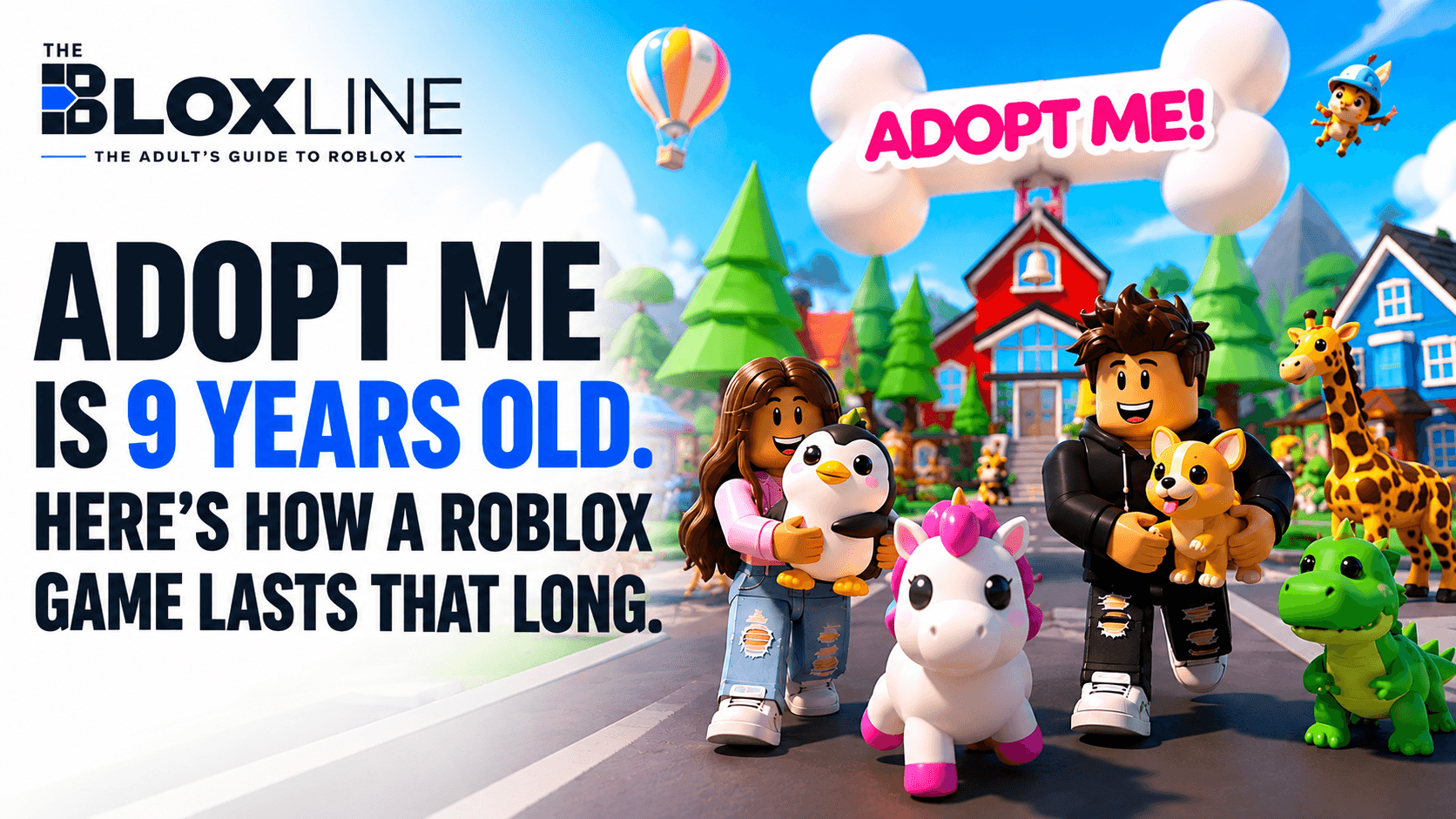
Roblox changes incredibly quickly. A game can appear almost overnight, attract millions of players, dominate YouTube and TikTok, and then find itself competing with another viral experience a few months later.
That makes the longevity of Adopt Me! particularly remarkable.
Adopt Me launched on Roblox in 2017. Nine years later, it remains one of the platform’s defining experiences.
The game has been played more than 40 billion times, according to developer Uplift Games, and has reached more than 425 million players worldwide.
For adults looking at Roblox from the outside, Adopt Me can appear fairly simple.
You collect pets. You look after them. You decorate homes. You trade with other players.
But its nine year lifespan tells a much bigger story about how successful Roblox games are becoming something closer to long running entertainment businesses.
What is Adopt Me?
Adopt Me is one of the most famous games on Roblox.
Today, the experience revolves heavily around collecting and caring for virtual pets, trading them with other players, customising homes and spending time in its social world.
But Adopt Me did not begin as the pet collecting phenomenon it eventually became.
Uplift Games says the experience launched in 2017, with pets being introduced in 2019.
That addition fundamentally changed the trajectory of the game.
Pets gave players something to collect.
Something to develop.
Something to trade.
Something to show other players.
And, crucially, something new that could continually be added to the game.
Nine years is a long time in Roblox
This is the part of the story worth paying attention to.
Think about how much gaming culture has changed since 2017.
Children who started playing Adopt Me when they were eight could now be 17.
Someone who discovered it at 12 could now be 21.
Entire waves of Roblox games have appeared during that period.
Yet Adopt Me has continued.
Uplift Games says the game has now been enjoyed by more than 425 million players and played more than 40 billion times. The studio has also previously recorded a peak of around 1.9 million concurrent players.
Those numbers matter.
But the more interesting question is:
How does a Roblox game remain relevant for nine years?
Adopt Me isn't really a finished game
One way to understand Adopt Me is to stop thinking about it like a traditional game.
Many conventional games have a relatively clear lifecycle.
A game launches.
People play it.
Perhaps downloadable content arrives.
Eventually, attention moves towards the sequel or another game.
Adopt Me works differently.
It behaves more like a live service.
The developers continually introduce new pets, events, items, activities and reasons for players to return.
The world players entered several years ago is not exactly the same experience somebody enters today.
That means Adopt Me never really has to be "finished".
It can continually evolve with its audience.
Pets created an almost perfect long term system
Pets are central to understanding the game's longevity.
Imagine if Adopt Me had a fixed collection of 50 pets and never added another one.
Eventually, dedicated players would collect everything they wanted.
Their reason to return would weaken.
But a continuously expanding collection changes that.
Every new pet can become another objective.
Players can want it.
Collect it.
Raise it.
Trade it.
Show it to friends.
Or add it to a collection they have spent years building.
That creates something extremely powerful in game design:
unfinished progress.
There is nearly always something else to obtain.
Trading makes the players part of the game
Adopt Me also contains something developers cannot simply manufacture through updates.
A player driven economy.
When players can trade pets and items with one another, those objects gain meaning beyond what the developer originally gives them.
Some become desirable.
Some become difficult to obtain.
Some become status symbols.
Players develop their own understanding of value.
Suddenly, collecting a pet is not only about owning something cute.
It becomes part of an economy.
That gives players another reason to understand the game deeply and remain involved.
The game gives players reasons to become emotionally attached
There is another important difference between collecting a weapon and collecting a virtual pet.
Pets are designed to create attachment.
Players name them.
Raise them.
Use them.
Trade them.
Remember when they obtained them.
For younger players especially, a collection can become a record of their time inside the game.
That makes leaving more difficult.
You are not simply abandoning progress on a leaderboard.
You may be leaving behind a collection you have spent years building.
Adopt Me understands events
Another reason long running games survive is that they turn updates into occasions.
Birthdays are a good example.
Adopt Me has historically celebrated its anniversary inside the game, including special Birthday Butterfly pets. Its eighth birthday celebrations in 2025 included the 2025 Birthday Butterfly, alongside rewards and other updates.
These events do more than add another item.
They create a moment.
A player who has not opened Adopt Me recently suddenly has a reason to return.
Long term games constantly need these reasons.
Christmas.
Halloween.
Birthdays.
New pets.
Limited items.
Collaborations.
Updates.
The calendar itself becomes part of the game's retention system.
Adopt Me became bigger than the people who originally made it
There is another remarkable part of this story.
Adopt Me did not remain a small Roblox development project.
Its success helped create an actual games company.
Uplift Games was formally launched in 2021 around the team behind Adopt Me. At that point, the game had already surpassed 22 billion visits and the development operation had grown to around 40 people.
Today, Uplift describes itself as a remote first studio across the UK and North America with more than 60 Roblox experts and games industry veterans.
That progression is important for adults trying to understand the Roblox economy.
A successful Roblox game can become the foundation of a conventional gaming business.
Developers become studios.
Studios employ artists, engineers, producers and marketers.
Games become intellectual property.
And that intellectual property can move beyond Roblox itself.
Adopt Me escaped the screen
Adopt Me now exists outside Roblox too.
Uplift Games has worked with companies including Jazwares, HarperCollins and Panini to turn the brand into physical products.
There are toys.
Plushies.
Books.
Apparel.
Accessories.
Collectibles.
That is a significant evolution.
A Roblox experience created virtual pets.
Those pets became recognisable characters.
Those characters became intellectual property.
And that intellectual property became physical merchandise.
For businesses watching Roblox, this is one of the clearest demonstrations of what successful Roblox IP can become.
Children can effectively grow up with the same Roblox game
There is also something culturally interesting happening here.
Nine years is a significant portion of a young person's childhood.
Someone can discover Adopt Me in primary school and still have their account, pets and memories attached to the experience years later.
That creates something Roblox increasingly needs: nostalgia.
Minecraft has it.
Pokémon has it.
Nintendo has it.
Older gamers can remember the games they played when they were children.
Roblox is now old enough for its own generation of players to begin having those same memories.
Uplift Games actually describes its mission as creating "future nostalgia."
Adopt Me might be one of the clearest examples of that happening.
Longevity is becoming even more important to Roblox
The timing of Adopt Me's ninth birthday is particularly interesting because Roblox itself is changing how it thinks about successful games.
In June 2026, Roblox announced that its Recommended For You algorithm was expanding from measuring behaviour over seven days to a 28 day view focused more directly on long term retention.
In simple terms, Roblox increasingly wants to recognise games people continue returning to rather than only games generating immediate attention.
Adopt Me represents the extreme version of that idea.
Not seven days.
Not 28 days.
Nine years.
Roblox is currently encouraging developers to create deeper experiences capable of becoming long term favourites.
Adopt Me demonstrates that Roblox has already produced games capable of achieving extraordinary longevity.
Viral success and lasting success are different
This is an important distinction when looking at Roblox charts.
A new experience reaching hundreds of thousands of concurrent players is exciting.
But that tells us what is happening now.
It does not tell us what will happen in three years.
Building a game that lasts requires something different.
Players need reasons to return after the initial excitement disappears.
Adopt Me has built several of those reasons into the same ecosystem:
- collecting
- trading
- social interaction
- personalisation
- progression
- regular updates
- limited events
- emotional attachment
Each system reinforces another.
That is much harder to replicate than simply creating a viral mechanic.
The biggest achievement might not be 40 billion plays
The enormous numbers surrounding Adopt Me naturally attract attention.
More than 40 billion plays sounds almost absurd.
But nine years may actually be the more impressive number.
Visits measure scale.
Years measure durability.
Getting somebody to try your game is one challenge.
Getting them to return is another.
Building something capable of welcoming new generations of players while retaining an existing community for almost a decade is something else entirely.
That is why Adopt Me should increasingly be studied alongside long running online games rather than dismissed as simply a popular children's Roblox experience.
The Bloxline view
Adopt Me is important because it shows what the endgame of a successful Roblox experience can look like.
A game becomes popular.
The developers keep updating it.
Players build collections and relationships inside it.
A studio forms around it.
The game develops recognisable intellectual property.
That IP becomes merchandise, books and partnerships.
And years later, another generation of players discovers it.
That is no longer simply a successful Roblox game.
It is a franchise.
Roblox is currently searching for the next generation of experiences capable of keeping players around for years.
Developers looking for the answer could do worse than studying one that has already managed it for nine.