Clean a House Has 66 Million Roblox Visits. Why Is Virtual Cleaning So Satisfying?
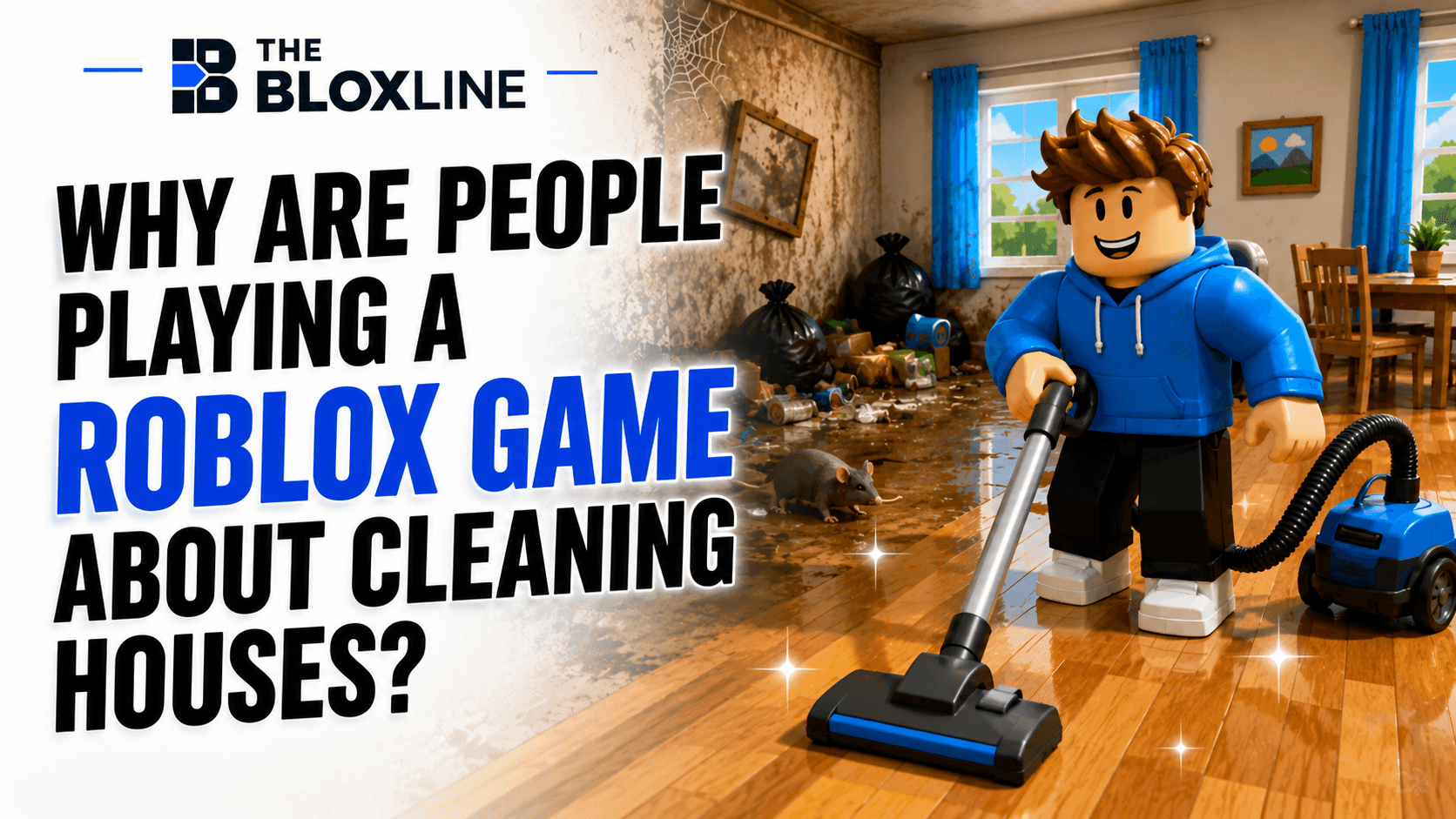
Cleaning a house is not something most people would normally describe as entertainment.
On Roblox, however, tens of millions of visits have been generated by a game built almost entirely around doing exactly that.
Clean a House is a Roblox experience created by developer cakehunterman. The idea is extremely easy to understand: players enter dirty houses, clean them, earn money for doing the work, improve their equipment and eventually move on to bigger properties. There are also rats to deal with, because apparently even virtual housework needs something to make it more stressful.
At first glance, it might look like another simple Roblox simulator. But Clean a House is interesting because it sits inside a much wider trend in gaming.
Games about cleaning, organising, renovating and turning messy spaces into tidy ones have become a genuine genre. Titles such as PowerWash Simulator and House Flipper have already demonstrated that adults will happily spend their free time performing virtual versions of jobs they might avoid doing at home. More recently, PC gaming has seen another wave of games built around sorting books, organising shops and putting thousands of objects back where they belong.
Clean a House shows how naturally that idea translates to Roblox.
What is Clean a House?
The basic premise could probably be explained to someone in less than a minute.
You clean houses.
Cleaning earns you money.
Money allows you to improve your tools.
Better equipment helps you clean more effectively.
You can then improve your plot and work on bigger houses.
That creates the central progression loop:
Clean → earn money → upgrade → clean bigger houses → earn more money → upgrade again.
The game also supports multiplayer. Its recent Friendship Update specifically encourages players to clean houses alongside friends and other players.
None of this requires someone to understand a complicated story or learn an elaborate set of systems before they can start having fun.
You see dirt.
You have something capable of removing the dirt.
You remove it.
The game rewards you.
That simplicity is important.
Why would anyone want to play a game about cleaning?
This is probably the obvious adult question.
If cleaning your actual house can feel like work, why would somebody voluntarily clean a virtual one?
The answer is that the game removes many of the unpleasant parts of real cleaning while keeping the satisfying part.
In real life, cleaning takes effort. You have to get the products out, move things around, scrub surfaces, empty bins and sometimes spend hours working before the house feels significantly different.
A video game can compress that entire process.
The player performs a simple action and immediately sees dirt disappearing.
A messy area becomes clean.
The game acknowledges the work.
Money goes up.
Progress increases.
You move on.
That transformation is satisfying because the player can clearly see what they have accomplished.
There is very little ambiguity.
The room was dirty. Now it is clean. You did that.
That is an unusually clear form of progress.
The game turns work into progression
Clean a House also does something important that real housework usually does not.
It pays you.
The money is obviously virtual, but it gives every cleaning task a second purpose. Players are not only cleaning because removing dirt is satisfying. They are cleaning because the money they earn allows them to progress further through the game.
This changes how the activity feels.
Imagine cleaning a dirty floor.
By itself, that is simply a task.
Now imagine that cleaning the floor earns enough money to buy a better cleaning tool.
That tool allows you to clean more efficiently.
Greater efficiency allows you to tackle a larger house.
The larger house provides more opportunities to earn money.
Suddenly the mundane activity has become part of a progression system.
This is one of the fundamental tricks behind simulator-style games.
They take an ordinary activity and surround it with rewards.
Upgrades give players something to work towards
The upgrade system is particularly important because without it the game could quickly become repetitive.
If players cleaned exactly the same house with exactly the same equipment forever, there would be very little sense of progression.
Clean a House instead allows players to improve their tools and obtain better plots, eventually giving them access to larger houses.
This gives the player both short-term and long-term goals.
The short term goal might be cleaning the room directly in front of them.
The longer term goal is getting better equipment or reaching the next stage of progression.
That combination is powerful because the player is almost always working towards something.
Cleaning one patch of dirt matters because it contributes towards cleaning the room.
Cleaning the room matters because it contributes towards earning money.
Earning money matters because it contributes towards an upgrade.
The upgrade matters because it allows the player to progress further.
One simple action therefore feeds into a much larger system.
Clean a House has already reached a substantial audience
This is not simply a tiny experimental Roblox game.
Third-party Roblox analytics service Rolimon's currently records more than 66 million visits for Clean a House. It also records more than 84,000 favourites and an all-time peak of more than 42,000 concurrent players.
Concurrent players means people inside the game at the same time, rather than the total number of visits accumulated over its lifetime.
Its recorded average playtime is a little over nine minutes.
That might not sound particularly long compared with a traditional game somebody could play for several hours, but Roblox works differently.
Experiences compete inside a platform where players can move from one game to another extremely quickly. A short session can still be valuable, particularly when players repeatedly return or when millions of people try the experience.
Clean a House therefore does not need to convince somebody to spend an entire evening cleaning virtual kitchens.
It needs to make cleaning satisfying enough that they want to complete the next task.
The rats are more important than they look
There is also a deliberately silly complication.
The game's description warns players not to let rats roam around.
That might sound like a small comedic addition, but mechanics like this can stop a simulator from feeling like nothing more than repeatedly clicking on dirty objects.
The cleaning provides the predictable part of the experience.
Unexpected problems provide disruption.
This is important because satisfaction and tension can work together.
Players want to create order, while the game introduces things capable of disrupting that order.
It gives the player something to react to rather than simply following the same cleaning routine indefinitely.
Playing with friends changes the experience again
Clean a House has also expanded its social side.
The game's Friendship Update allows players to clean alongside friends and other players.
That may seem like a small feature, but multiplayer can fundamentally change a repetitive task.
Cleaning alone is a progression game.
Cleaning with somebody else can become a shared activity.
Players can divide work, compare progress, mess around while cleaning or simply talk while completing relatively low-pressure tasks.
Roblox is particularly suited to this because games are not always competing purely on traditional gameplay.
Sometimes the game provides the activity people perform while spending time together.
The activity needs to be engaging enough to keep people occupied without demanding so much concentration that the social element disappears.
Cleaning can fit that role surprisingly well.
This is not actually a new idea in gaming
Clean a House might look like a strange Roblox phenomenon, but cleaning games have existed for years.
The wider games industry has already discovered that turning disorder into order can be extremely satisfying.
PowerWash Simulator revolves around washing dirt from objects and environments.
House Flipper revolves around cleaning, renovating and improving properties.
Unpacking turns taking possessions out of boxes and organising them into rooms into the central gameplay.
And in 2026, PC gaming has seen another wave of games focused specifically on tidying and sorting. One successful example asks players to return thousands of books to their correct positions in a library. Others involve organising toys, wine bottles and shops.
The environments are different, but the psychological reward is similar.
Something begins messy and ends organised.
The player creates that transformation.
Clean a House packages the same basic satisfaction inside the progression-heavy structure that works particularly well on Roblox.
Roblox has a history with cleaning games too
Clean a House is also not Roblox's first attempt at turning cleaning into entertainment.
An older experience simply called Cleaning Simulator became memorable enough that players are still trying to rediscover it years later.
The game puts players in the role of unusual janitors working for a fictional company called BRIBBLECO. Players can explore and clean its building alone or alongside friends.
Interestingly, Reddit posts from 2026 show former players describing half remembered details from a Roblox cleaning game they played years earlier, only for other users to identify it as Cleaning Simulator.
That longevity is useful context.
Cleaning is not suddenly working on Roblox because somebody discovered an entirely new type of gameplay.
There has been an audience for it for years.
What changes is how developers package that activity.
Why cleaning games work particularly well on Roblox
Roblox is well suited to games built around repetitive improvement because the platform has a huge audience already familiar with simulator mechanics.
A player does something simple.
A number increases.
They buy an upgrade.
The same activity becomes faster or more rewarding.
They unlock another area.
Then the cycle begins again at a larger scale.
Clean a House fits neatly into that structure.
But cleaning adds another layer that some simulator mechanics do not have.
You can see the progress in the environment itself.
If a simulator asks you to click a button 1,000 times, your main indication of progress might simply be a larger number.
Cleaning gives you two forms of feedback.
Your money increases, but the world around you also changes.
Dirty becomes clean.
Messy becomes tidy.
A neglected property becomes something better.
That visual transformation makes progression easier to feel.
There is a bigger trend here for Roblox studios
The success of Clean a House is another reminder that Roblox studios do not necessarily need to invent completely new activities.
Sometimes an ordinary activity becomes interesting once the developer asks the right questions.
How can we make this faster?
How can we make it more satisfying?
How can we show progress clearly?
What can players upgrade?
What can they unlock?
What changes visually as they improve?
How can friends participate?
What unexpected problems can interrupt the routine?
Those questions can transform something as mundane as cleaning into a game capable of generating tens of millions of visits.
That is worth paying attention to because Roblox developers regularly turn ordinary real world activities into scalable entertainment.
Running a supermarket.
Working in a restaurant.
Driving vehicles.
Building houses.
Fishing.
Gardening.
Cleaning.
The activity itself does not have to sound exciting.
The progression surrounding it does.
The Bloxline view
Clean a House is interesting precisely because cleaning sounds like such an unlikely foundation for a successful game.
But once you strip away the real-world inconvenience, the appeal becomes much easier to understand.
Cleaning offers something games constantly try to give players: visible progress.
There is a problem directly in front of you. You solve it. The environment immediately looks better. The game rewards you. Then it gives you a slightly bigger problem.
That loop is easy to understand, easy to repeat and easy to expand.
It also connects Roblox to a much wider movement across gaming. Cleaning and organisation games are no longer unusual curiosities. There is clearly an audience that finds the process of transforming disorder into order genuinely enjoyable, from PowerWash Simulator and House Flipper to the current wave of sorting games appearing on PC.
Clean a House takes that satisfaction and combines it with Roblox's familiar simulator progression.
The result has already generated more than 66 million visits according to third party tracking.
For studios, the lesson is useful.
A game does not always need to make an exciting activity playable. Sometimes it can take an ordinary activity and make the progress exciting.