Fortnite Is Bringing 99 Nights in the Forest Into Its Next Season. That Is a Big Moment for Roblox Games
For years, Fortnite has built part of its identity around bringing other entertainment properties into its world.
Marvel, Star Wars, Dragon Ball, musicians, sports stars and major video game franchises have all appeared in Fortnite in some form.
Now that list is expanding in a particularly interesting direction for Roblox.
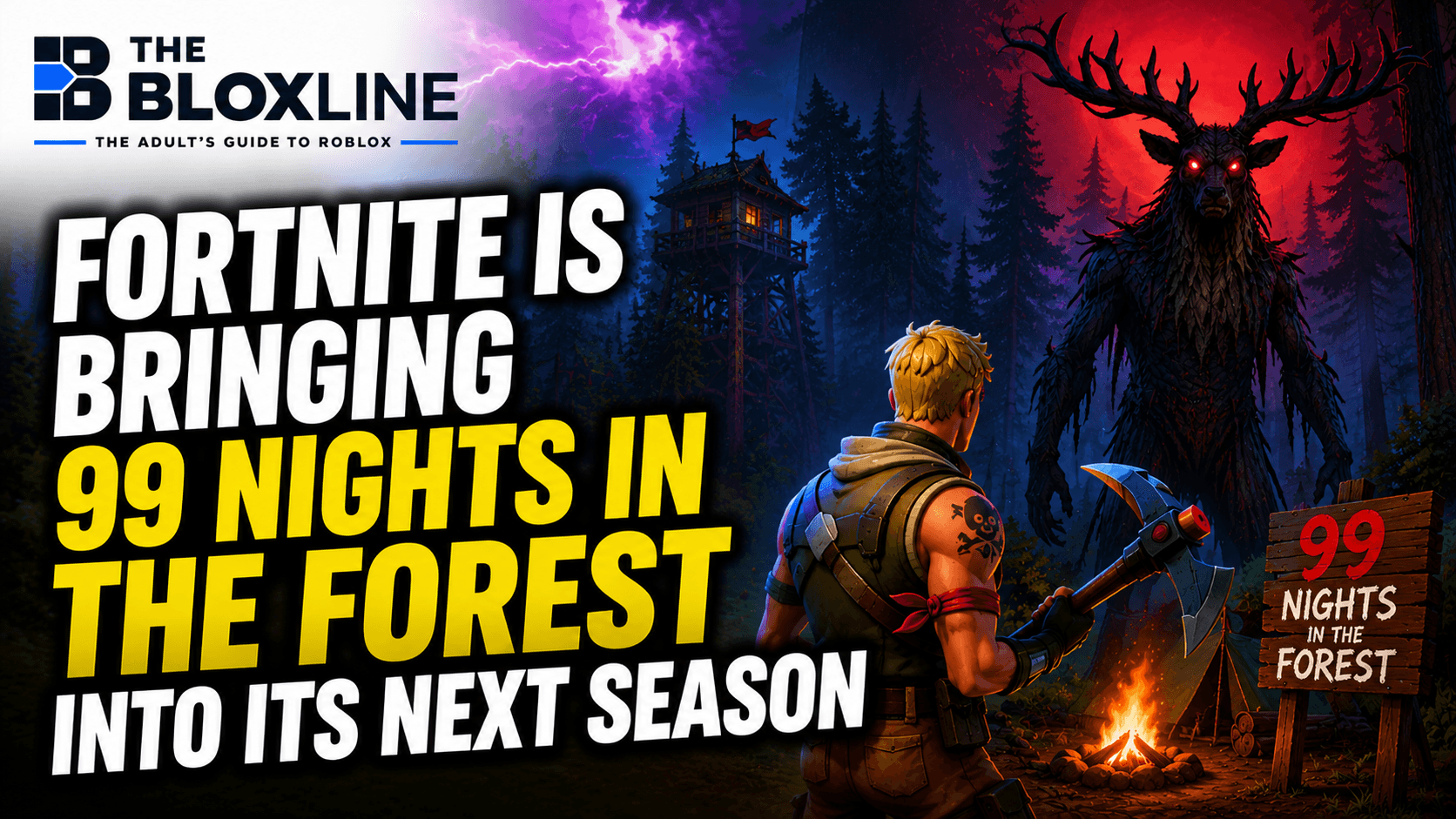
99 Nights in the Forest, one of the biggest experiences on Roblox, is officially crossing over with Fortnite as part of Fortnite Chapter 7 Season 4. The collaboration has been teased ahead of the new season, which begins on August 20.
For people who do not follow Roblox closely, this could easily look like another Fortnite collaboration.
It is much more significant than that.
99 Nights in the Forest did not begin as a traditional standalone video game released on PlayStation, Xbox, Nintendo Switch or Steam. It was built inside Roblox.
That means a game created within Roblox has become culturally valuable enough for one of the world's biggest games to license it for a crossover.
For Roblox studios, that is an important milestone.
What is 99 Nights in the Forest?
99 Nights in the Forest is a survival game created by Grandma's Favourite Games.
Players enter a forest where they need to gather resources, build and maintain a camp, work with other players and survive increasingly dangerous nights.
The basic idea is easy to understand.
During the safer periods, players prepare.
They collect resources and improve their chances of surviving.
When darkness arrives, the forest becomes much more dangerous.
One of the game's most recognisable elements is The Deer, the unsettling creature associated with the experience.
The game mixes survival, horror and cooperative gameplay without becoming as complicated as many traditional survival games. That accessibility has helped it reach an enormous audience.
The official Roblox page currently records more than 28 billion visits and over 8.7 million favourites.
Third party reporting has also documented the game surpassing 14 million simultaneous players during one of its peaks.
Those numbers provide important context for the Fortnite collaboration.
99 Nights in the Forest might be unfamiliar to an adult who does not spend time on Roblox, but that does not make it a small game.
It is already operating at enormous scale.
What is happening with Fortnite?
Epic Games has confirmed that 99 Nights in the Forest will be involved with Fortnite's next season.
The collaboration was revealed through a teaser featuring The Deer, immediately connecting Fortnite's new season with one of 99 Nights in the Forest's most recognisable characters. The new Fortnite season is scheduled to begin on August 20, 2026.
99 Nights in the Forest is also joining a season heavily focused on gaming collaborations, with Sonic the Hedgehog among the other confirmed properties appearing alongside it.
At the time of writing, however, it is important not to overstate exactly what the collaboration will contain.
The crossover has been confirmed, but every individual cosmetic, gameplay feature and piece of content associated with it has not necessarily been officially detailed yet.
That distinction matters.
What we know is already significant enough: Fortnite has chosen a Roblox-native game as one of the gaming properties it wants represented in its ecosystem.
This is bigger than one collaboration
The interesting story for The Bloxline is not really whether Fortnite players will be able to dress as The Deer.
It is what had to happen for a collaboration like this to become possible.
Historically, there has been a tendency outside Roblox to treat Roblox games differently from "real" video games.
Part of that comes from the structure of Roblox itself.
Roblox is a platform containing millions of experiences, rather than one single game. Someone downloads Roblox and then chooses between games created by different developers and studios.
To an adult looking from the outside, those experiences can therefore feel like small pieces of user-generated content.
That description increasingly fails to explain what the largest Roblox games have become.
99 Nights in the Forest has its own developer team, gameplay systems, audience, characters, visual identity and intellectual property.
Most importantly, millions of people recognise it.
Fortnite licensing that identity makes the distinction much harder to ignore.
Roblox games are becoming entertainment properties
This is where the story becomes particularly interesting for studios.
Building a successful Roblox game once primarily meant attracting players inside Roblox.
That is still obviously important.
But the biggest experiences are increasingly capable of becoming intellectual property beyond Roblox itself.
Think about what a recognisable game can eventually contain:
- Characters
- Creatures
- Locations
- Stories
- Merchandise
- Music
- Toys
- Books
- Television or film potential
- Licensing opportunities
- Collaborations with other games
A Roblox experience can therefore become the starting point rather than the final product.
99 Nights in the Forest has a particularly useful asset in The Deer.
You do not need to understand every mechanic in the game to recognise the creature.
That matters enormously when intellectual property starts travelling between platforms.
Fortnite does not need to recreate the entire 99 Nights in the Forest experience to communicate the collaboration. A recognisable character can carry much of that identity.
Fortnite is effectively validating Roblox-native IP
There is another way to look at what has happened.
Fortnite collaborations are valuable because Fortnite has become a meeting point for entertainment brands.
A Fortnite season can contain characters originating from completely different parts of popular culture.
That means inclusion itself carries a message.
A property is considered recognisable enough to contribute something to Fortnite's enormous crossover ecosystem.
99 Nights in the Forest now sits inside that conversation.
It is particularly striking because the next Fortnite season is bringing together established gaming properties and a game born inside Roblox.
The important distinction is that Fortnite is not simply collaborating with Roblox Corporation.
The attraction here is a specific experience created within Roblox.
That gives studios building on the platform something worth thinking about.
Roblox studios are not necessarily just building Roblox games
A developer might begin with Roblox because the platform provides access to an enormous existing audience and the infrastructure required to create and distribute a game.
But if that experience becomes successful enough, the intellectual property created around it can potentially travel elsewhere.
This changes the ambition available to Roblox studios.
A studio does not necessarily have to think:
How big can our Roblox game become?
The bigger question could eventually become:
How big can the property we created on Roblox become?
Those are very different questions.
One focuses on performance within a platform.
The other starts thinking about franchises.
99 Nights in the Forest appearing in Fortnite provides a tangible example of that second possibility.
It also changes how the wider games industry should look at Roblox
Traditional game companies should pay attention to this too.
Roblox has become an enormous testing ground for game concepts.
Millions of players are constantly deciding what they want to play, what characters they care about and what games they want to return to.
Successful experiences therefore generate something incredibly valuable: evidence.
A Roblox studio does not necessarily have to convince another entertainment company that its idea might find an audience.
In the biggest cases, the audience already exists.
99 Nights in the Forest has accumulated more than 28 billion visits according to Roblox's own listing.
That does not mean 28 billion individual people have played it. Visits count sessions rather than unique users, so one person can contribute many visits.
But it still demonstrates extraordinary activity around the property.
When a game reaches that kind of scale, companies outside Roblox have a reason to notice.
Fortnite could introduce 99 Nights to people who do not play Roblox
There is also a fascinating movement happening in the opposite direction.
Normally, adults might think about Roblox benefiting from established entertainment brands.
A famous movie enters Roblox.
A major sports league launches a Roblox experience.
A fashion company creates virtual items.
An established game franchise brings its characters onto the platform.
The assumption is that Roblox receives cultural credibility from something that became famous elsewhere.
99 Nights in the Forest reverses that relationship.
The property became famous inside Roblox first.
Now Fortnite can expose it to people who may never have played the original Roblox experience.
Some Fortnite players will immediately recognise The Deer.
Others will encounter it for the first time and potentially discover that it originates from a Roblox game.
That is a significant change in direction.
Roblox is not only importing culture anymore. It is exporting it.
Not every Fortnite player is happy about it
The reaction also reveals that perceptions of Roblox have not completely caught up with its scale.
Some Fortnite community discussions have questioned why a Roblox experience deserves representation alongside more established gaming franchises. Others have argued that different gaming properties would have been more appropriate choices.
That reaction is interesting in itself.
There is still a cultural divide between traditional gaming audiences and Roblox audiences.
For some players, something originating on Roblox can still feel less legitimate than a game released through conventional PC or console channels.
But commercial relevance does not necessarily follow those cultural assumptions.
99 Nights in the Forest has reached player numbers that most conventional games will never approach.
Fortnite recognising that audience could be another sign that the wider games industry is beginning to take Roblox-native intellectual property more seriously.
This matters to brands too
Brands and entertainment companies watching Roblox should pay particular attention to what this represents.
Roblox should increasingly be viewed not simply as somewhere established intellectual property goes to reach younger audiences.
It is becoming somewhere new intellectual property can originate.
That creates a different kind of opportunity.
Entertainment companies could potentially discover emerging characters, game concepts, studios and communities on Roblox before those properties become widely recognised elsewhere.
The same logic already exists across other entertainment industries.
YouTube creates creators who eventually become mainstream celebrities.
TikTok produces songs that move into the charts.
Wattpad stories have become published books and films.
Social platforms can act as enormous cultural incubators.
Roblox may increasingly play that role for interactive entertainment.
The Bloxline view
The Fortnite collaboration matters because of what it says about the changing status of Roblox games.
99 Nights in the Forest started as an experience inside Roblox.
It built an enormous audience there.
Its characters became recognisable.
Its intellectual property became valuable.
Now that intellectual property is moving into Fortnite.
That progression should change how studios, investors, brands and entertainment companies think about the platform.
The next major gaming property does not necessarily have to begin with a publisher, a console release and a multimillion pound development budget.
It could begin inside Roblox.
And the most important thing about 99 Nights in the Forest appearing in Fortnite may ultimately have very little to do with Fortnite itself.
It is evidence that a Roblox game can become culturally significant enough that other major games want its characters inside their worlds.
That is a major step in Roblox's evolution from a platform that hosts games into an ecosystem capable of creating entertainment franchises of its own.