I Stopped Watching My Children Play Roblox From Across the Room and Started Playing With Them
Playing Roblox with my children has turned part of their screen time into family time, while helping me understand their games, spending, emotions and online world.
There are plenty of reasons for parents to worry about Roblox.
It can be incredibly absorbing. Children can spend hours moving from one experience to another. There are concerns around spending, communication with strangers, inappropriate content and the simple question of how much screen time is too much screen time.
I understand those concerns because I am a parent too.
But at some point, I realised that simply standing outside Roblox and worrying about what my children were doing inside it was not necessarily helping me understand the thing that had become such a big part of their lives.
So I tried something different.
I started playing Roblox with them.
Not sitting beside them occasionally and watching. Not asking them what they were playing while only half understanding the answer. I actually created an account, entered the same experiences, learned how they worked and started playing alongside them.
It has completely changed my relationship with Roblox.
More importantly, it has given us another way to spend time together.
I finally understand what they are talking about
One of the biggest changes is also one of the simplest.
I can actually have conversations with my children about Roblox now.
When they tell me about a game, there is a good chance I understand what they mean. We can talk about where they need to go, what they need to do next, how they can improve their character, what they are trying to unlock or why something happened during a game.
That may sound insignificant to somebody who does not have children obsessed with Roblox, but it makes a difference.
Children have their own interests and worlds, and as they grow older, parents inevitably find themselves standing outside some of those worlds. We might not understand the YouTubers they watch, the language they use with friends, the games they play or why something that looks completely ridiculous to us is apparently the most important thing in the world to them that week.
Roblox could easily have become one of those things for me.
Instead, I decided to enter their world.
And once I did, Roblox stopped being this strange platform that my children disappeared into and became something we could actually talk about together.
Sometimes Roblox is genuinely family time
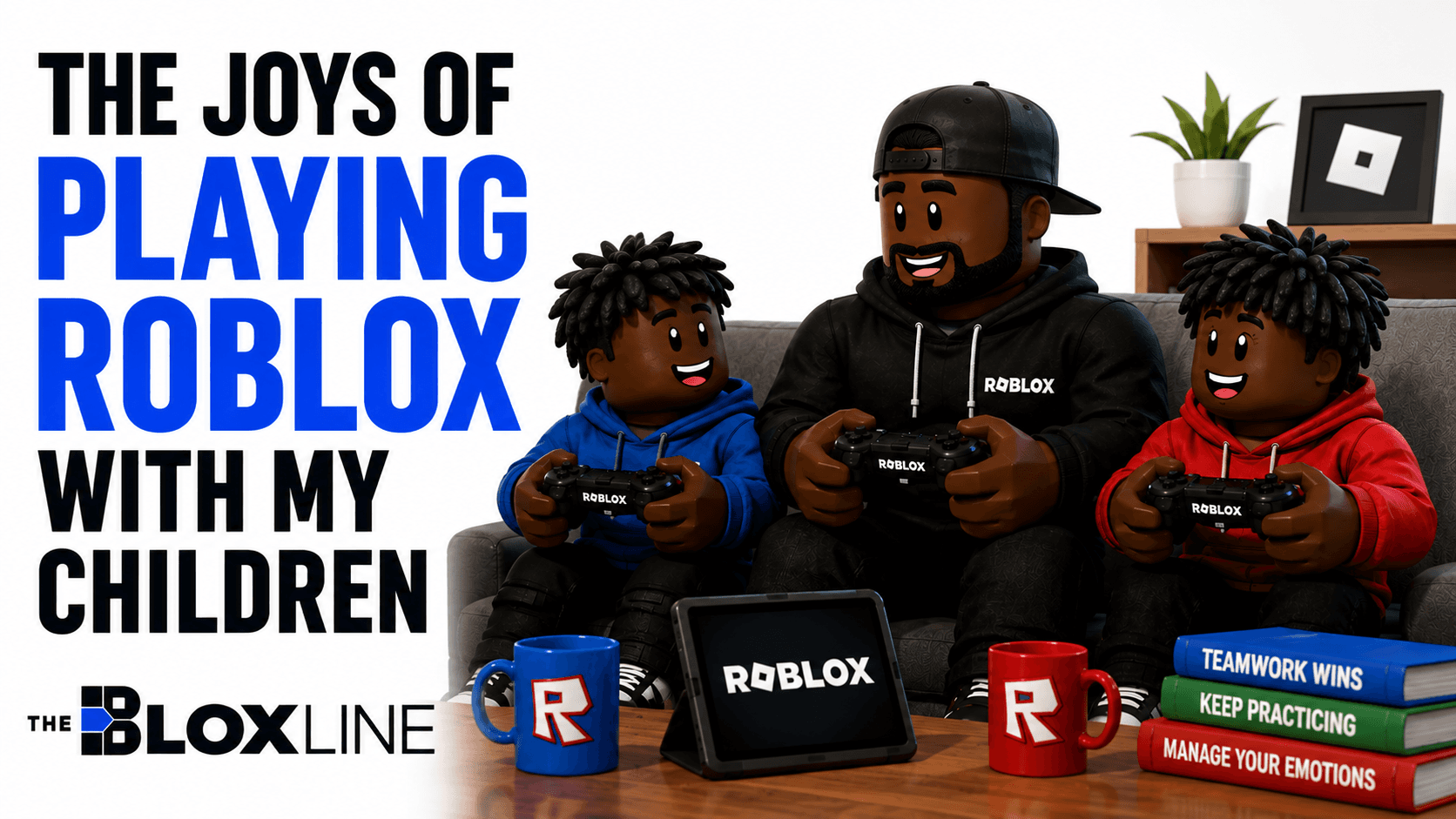
We have started playing two-player teamwork games together, particularly experiences such as Fire and Water 2 Player Obby and Fire Truck 2 Player Obby.
These games require us to cooperate.
One person might need to stand on something so the other person can get through a door. One player might need to activate something while the other waits. Sometimes one of us can see what needs to happen before the other does.
So we talk.
"Go over there."
"Wait for me."
"Press that."
"No, don't jump yet."
"You need to come back."
"I'll do this part and then you do that."
It is still Roblox. I am not going to pretend that playing a two-player obby is suddenly some revolutionary educational programme.
But my children are having to listen, explain what they want me to do, follow instructions, give instructions, wait for somebody else and understand that sometimes we only succeed when both of us do our part.
That is teamwork.
And because I am playing alongside them rather than simply watching them play, I get to experience those little moments with them.
Sometimes they know what to do and I don't.
They have to teach Dad.
I actually like that.
Roblox has given me a better way to talk about losing
There is another part of playing together that I did not expect to appreciate as much as I do.
Losing.
Children do not always respond particularly well when a game does not go their way.
There can be frustration. Anger. Complaining. Sometimes something happens in a game that feels completely unfair to them and their immediate reaction is emotional.
Before I played Roblox with them, I could respond as a parent.
"Don't get angry."
"It's only a game."
"Calm down."
Those things might be true, but they are coming from somebody standing outside the experience.
Now I can have that conversation inside the exact moment that caused the frustration.
I saw what happened.
I understand why they lost.
I know why they are annoyed.
That means I can explain why losing is part of the game, why getting angry will not change what happened and why sometimes the answer is simply to try again and get better.
It becomes a conversation about managing emotions rather than an adult telling a child to stop being upset about something the adult does not understand.
That distinction matters to me.
I understand what they want Robux for now
Robux is another area where being involved has made parenting Roblox considerably easier.
Children ask for Robux.
That is hardly a revelation.
But there is a big difference between hearing, "Dad, can I have Robux?" and having absolutely no idea what they intend to do with it, compared with actually understanding the game they are playing and what they want to buy.
Now I can ask questions that make sense.
What are you buying?
Why do you want it?
What does it actually do?
Is it permanent?
Is it just cosmetic?
Will it genuinely improve the experience for you?
Because I understand Roblox better, I have much more context around where the money is going.
That does not mean I automatically say yes.
If anything, understanding the platform makes it easier to make an informed decision when the answer needs to be no.
But I would rather understand what my child wants to spend money on than simply see Roblox as a mysterious machine that keeps asking parents for their bank cards.
Playing together also keeps more of the experience inside our family
Online communication is understandably one of the areas parents worry about with platforms such as Roblox.
What I have found interesting is that when we are actively playing together, my children have less reason to look elsewhere for interaction during that session.
They already have somebody to talk to.
Me.
If we need to work something out, we talk to each other. If something funny happens, we laugh about it together. If somebody needs help, we help each other.
The social experience is happening inside our house.
I would never suggest that playing Roblox with your children somehow removes every online safety concern. It doesn't. Parents still need to understand the platform's safety settings, communication features and the experiences their children are entering.
But there is a big difference between supervising a child's online life from a distance and occasionally being part of that online life with them.
Sometimes I can even tell them what's happening on Roblox
Something happened recently that made me realise how much our roles had changed.
Because I had been playing +1 Speed Keyboard Escape myself, I knew that the game was holding an Admin Abuse event.
So I told my son about it.
He joined.
And he had a great time.
That was a funny little moment because normally I would expect my children to be the ones telling me what was happening on Roblox.
This time Dad had the Roblox news.
Had I remained completely disconnected from the platform, I would never have known the event existed, never mind been able to tell him about it.
It was not some enormous parenting milestone.
It was simply a nice experience that my son enjoyed because I happened to understand something he was interested in.
And I think those small things count.
I've stopped looking at Roblox entirely from an adult's perspective
This may be the biggest thing Roblox has given me as a parent.
Perspective.
It is very easy to look at Roblox from the outside and see noise.
Bright colours. Strange characters. Repetitive games. Children screaming about Robux. Experiences with names that barely make sense. Trends appearing seemingly from nowhere.
From that position, it is also very easy to dismiss the entire thing.
Then you actually play.
You begin to understand why progression feels satisfying. You understand why getting a better item matters. You understand why your child wants to rebirth their character even though doing so appears to reset everything they just spent an hour achieving. You understand why everyone suddenly wants to play a particular game.
You start seeing the platform from something closer to their perspective.
I don't have to love everything my children love.
But understanding why they love it makes it much easier to parent them around it.
This doesn't mean ignoring the problems with Roblox
I think this point is important.
My response to concerns around Roblox is not that parents should simply play the game and stop worrying.
There are legitimate conversations to have about safety, spending, screen time, addictive game mechanics, communication and the kinds of experiences children can encounter.
Playing alongside my children does not make those issues disappear.
What it does is make me considerably better equipped to deal with them.
It is difficult to guide a child through a digital environment you fundamentally do not understand.
You can set rules.
You can impose limits.
You can say no.
Sometimes those things are absolutely necessary.
But understanding the environment gives those decisions context.
Instead of Roblox simply being "that game the children play", I know what an obby is. I understand Robux. I understand progression. I understand why certain games are exciting. I understand how experiences encourage players to keep going.
That knowledge makes me feel more capable as a parent navigating Roblox, not less cautious.
There is a difference between monitoring and participating
Before all of this, I could see my children playing Roblox from across the room.
Technically, I was present.
But being in the same room is not necessarily the same thing as being involved.
Now I can walk past and recognise what they are playing.
I can ask them whether they like it.
I can ask what they are trying to achieve.
I can understand the answer.
And when I have the time, I can join them.
That last part has become important to me.
There are endless conversations about how parents should manage children's screen time, and those conversations are necessary, but perhaps we should occasionally ask another question too.
What happens when some of that screen time becomes shared time?
It does not magically stop being screen time.
But the experience changes.
Instead of my child being on Roblox while I am somewhere else, sometimes we are playing something together.
We are communicating.
We are solving something.
We are laughing when one of us makes a ridiculous mistake.
We are getting annoyed when we have to repeat the same section for the tenth time.
And eventually, hopefully, we beat it together.
I don't want to spend their childhood standing outside their digital world
Children are growing up with digital spaces playing a much larger role in their lives than they did for many of us.
As parents, we can dislike parts of that reality. We can put boundaries around it. We absolutely should protect our children where necessary.
But I also think there is value in understanding the places where our children choose to spend their time.
For my family, playing Roblox together has given me another small window into their world.
I am no longer looking across the room at a screen and wondering what they are doing.
I can ask.
I can understand.
Sometimes I can help.
Sometimes they help me.
And sometimes I can grab my own device, join their server and experience it with them.
I started playing Roblox because I wanted to understand what my children were spending so much time doing.
I didn't expect that understanding Roblox would also give us another way to understand each other.
That has been the part I've appreciated most.