Roblox Now Checks Whether Account Behaviour Still Matches a User’s Verified Age
When most parents think about age verification, they imagine a simple process. A person proves their age once, receives access to age appropriate features, and that’s the end of it.
Roblox says that is no longer enough.
As the platform introduces more age specific features, it also wants greater confidence that the person using an account today is the same age as the person who originally verified it. That has led Roblox to develop a system that looks at patterns of account behaviour over time to help determine whether an account still appears to match its verified age.
For parents, this raises two important questions. How does it work, and what does it mean for family accounts?
Why Roblox is changing its approach
Roblox has invested heavily in age verification over the past few years.
Features such as age restricted chat, social experiences and certain communication tools rely on the platform having confidence in a user’s age.
But there is a problem.
A selfie or facial age check only confirms who completed the verification at that moment.
It cannot guarantee that the same person continues using the account weeks or months later.
For example:
- A parent could verify an account before allowing a younger child to use it.
- Older siblings could share accounts with younger siblings.
- Someone could deliberately use another person’s verified account to gain access to features intended for older users.
From Roblox’s perspective, a one time age check cannot solve those situations.
What Roblox is doing differently
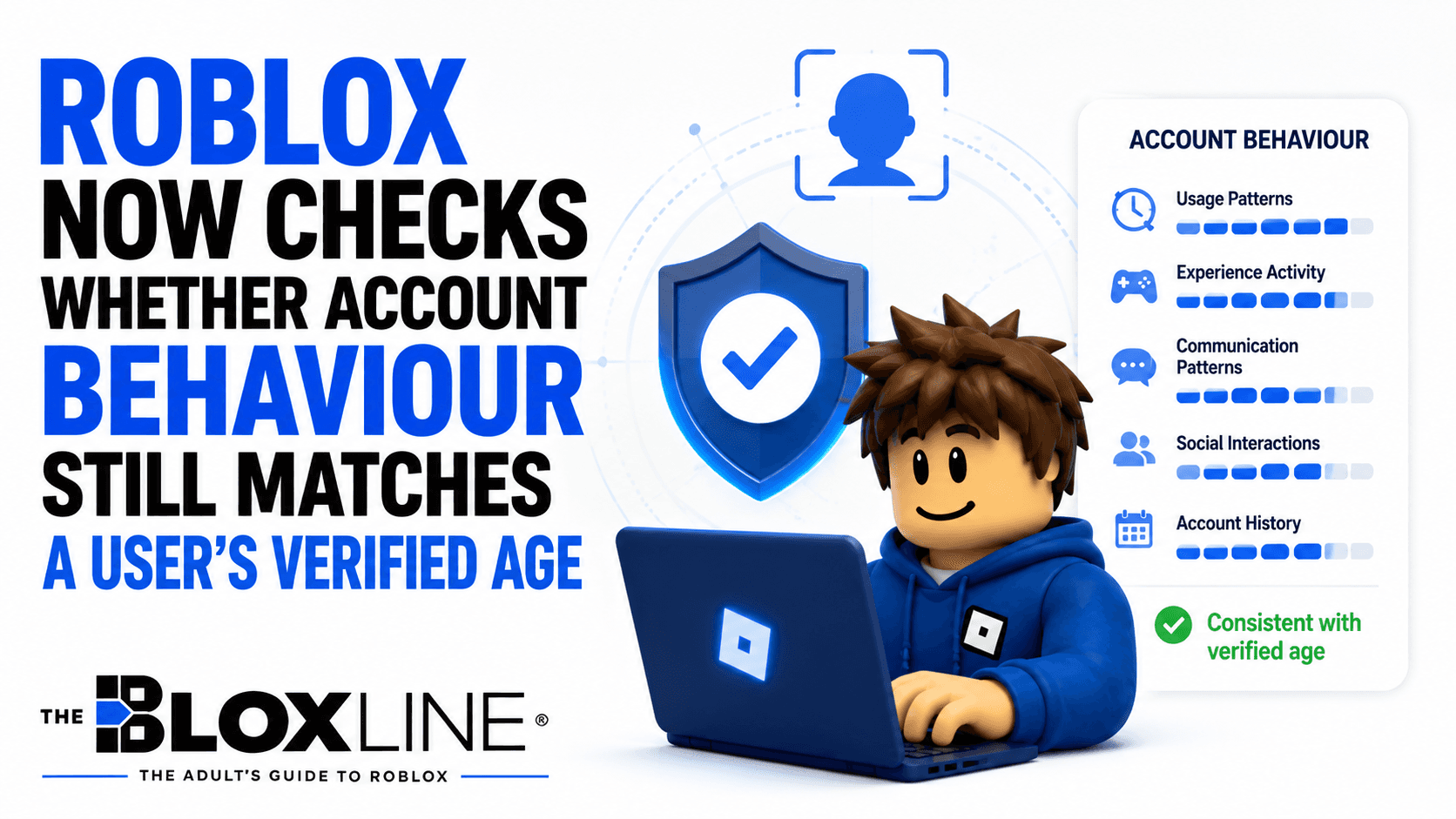
Instead of relying entirely on the original verification, Roblox has developed a machine learning system that continually looks for signs that an account still appears consistent with its verified age.
The company says the system examines broad patterns of activity rather than making decisions based on one single action.
Examples include:
- When the account is typically active.
- How frequently it is used.
- The types of experiences it visits.
- General communication patterns.
- Social interactions with other users.
- Overall usage behaviour.
Roblox says these signals work together to help estimate whether an account continues behaving like it belongs to the same age group.
Importantly, Roblox has not published a checklist of behaviours that automatically trigger changes. The system looks at combinations of signals rather than one individual activity.
Does Roblox read everything children do?
This is one of the biggest questions parents are likely to ask.
Roblox explains that its system is designed around machine learning models using aggregated behavioural features rather than employees manually reviewing everything players do.
The company also says it stores derived information wherever possible instead of retaining complete raw histories of every activity.
That does not mean behaviour is ignored.
It means patterns are analysed by automated systems to help support age assurance.
Why account sharing matters more than ever
Many families have shared Roblox accounts over the years.
Sometimes a younger sibling inherits an older child’s account.
Sometimes parents create one account for several children.
Sometimes an adult verifies an account before allowing a child to play.
Under Roblox’s newer approach, those habits could create problems.
If the account consistently behaves like it belongs to a different age group than the verified user, Roblox’s systems may identify that mismatch as part of its ongoing safety processes.
The simplest approach is also the safest.
Each family member should have their own Roblox account using their real date of birth.
Why Roblox believes this is necessary
The more Roblox grows, the more important age becomes.
Different age groups may receive access to:
- Different communication tools.
- Different social features.
- Different safety protections.
- Different discovery experiences.
- Different community interactions.
Without confidence in age, Roblox cannot safely introduce experiences designed specifically for teenagers or adults while continuing to protect younger players.
Age assurance is becoming part of the platform’s infrastructure rather than simply another account setting.
Could the system make mistakes?
Yes.
Roblox itself acknowledges that behaviour does not perfectly predict someone’s age.
Adults and children sometimes enjoy the same games.
Families often play together.
Different countries and cultures use Roblox differently.
No machine learning system can determine someone’s age with complete certainty based only on behaviour.
That is why Roblox describes behavioural analysis as supporting its wider age assurance system rather than replacing identity checks altogether.
What this means for privacy
Any system that analyses behaviour naturally raises questions about privacy.
Parents should understand that Roblox is using patterns of account activity to strengthen safety decisions.
The company says it has designed the system to reduce the amount of information stored wherever possible and to focus on features generated by machine learning rather than keeping detailed records of every action.
For many families, the debate will become one of balance.
Would they rather Roblox rely only on a one time selfie, or continue checking whether an account still appears appropriate for its verified age?
There is no answer that satisfies everyone, but it is a conversation more online platforms are beginning to have.
What parents should do
You do not need to panic or make major changes overnight.
Instead, use this as an opportunity to review how Roblox is used in your home.
Ask yourself:
- Does every child have their own account?
- Is each account using the correct date of birth?
- Has an adult ever verified an account that is actually used by a child?
- Are parental controls configured correctly?
- Do children understand why they should not share accounts?
These simple checks will help ensure Roblox’s safety systems work as intended.
Why this matters beyond Roblox
Roblox is unlikely to be the last platform to move in this direction.
Across technology, companies are exploring ways to verify not only who someone is today, but whether an account continues being used by the same person over time.
As online services introduce more age based experiences, continuous age assurance may become increasingly common.
That makes this story important even for adults who do not regularly play Roblox.
It offers a glimpse into how future online safety systems may operate across games, social platforms and other digital services.
The Bloxline insight
The biggest shift is not that Roblox can estimate someone’s age.
It is that age verification is becoming an ongoing process rather than a single event.
For parents, that means thinking differently about account sharing. An account is no longer simply a login. It represents a specific individual, and Roblox increasingly expects the behaviour of that account to match the person it was created for.
As Roblox expands age specific features, that expectation is likely to become even more important.