Roblox Has a $30 Game. Could Paid Games Change What Studios Build on the Platform?
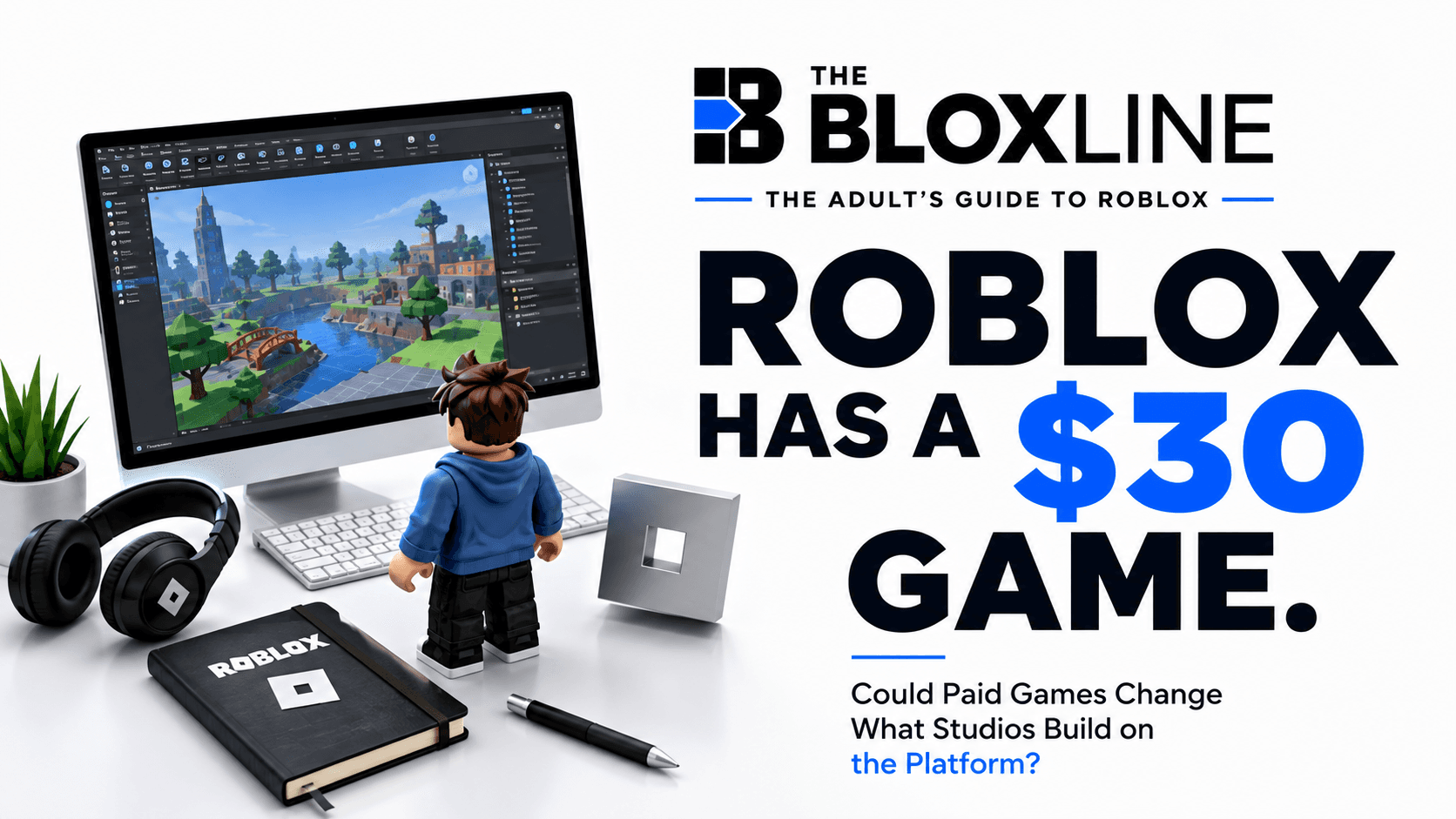
Most Roblox games are free to start playing. A player chooses an experience, enters it without paying, and the developer then has various ways to make money through purchases made inside the game.
Egg Hunt 2026: The Grand Eggspress is taking a different approach. The complete game costs $29.99, using a Roblox system that allows eligible developers to charge players real money for access to an experience.
A $30 Roblox game is unusual enough to attract attention on its own, but the price is not really the important part of this story. Roblox wants professional studios to build larger and more sophisticated games for an audience that is gradually getting older. Those games cost more to make, which means developers need business models capable of supporting larger development budgets.
Paid games could become one of those models.
The question The Grand Eggspress is helping to test is whether Roblox can become a place where studios do not only make free to play experiences, but can also build complete games and sell them in much the same way developers already sell games on PC and consoles.
What is Egg Hunt 2026: The Grand Eggspress?
Egg Hunt 2026: The Grand Eggspress is a 3D platforming adventure inspired by Roblox's long history of Egg Hunt events, where players explore environments in search of collectible eggs.
This version is considerably more ambitious than a simple seasonal event. Players travel aboard the Grand Eggspress through six different worlds, completing quests, solving puzzles and searching for more than 100 collectible eggs along the way. Dentsu, which is involved in the project alongside GeekOut and Studio Koi Koi, says the complete experience contains more than ten hours of gameplay, with additional live content planned after launch.
The developers are therefore asking players to treat this more like a complete commercial game than the kind of short Roblox experience that can be sampled for free and abandoned after a few minutes.
That distinction matters because the economics of making the two can be very different.
Roblox developers can now sell games for real money
Adults unfamiliar with Roblox may assume that every experience on the platform has to be free, with developers making their money from Robux purchases afterwards. That is no longer the case.
Roblox's local currency paid access system allows eligible developers to sell access to their games using real world money. On computer and web, Roblox currently provides price points of $9.99, $29.99 and $49.99, with different developer revenue shares attached to each tier.
At $9.99, the creator share is 50%. At $29.99, it rises to 60%, while the $49.99 tier provides a 70% creator share. Taxes, VAT and other applicable fees can still affect the final amount.
At the simplest level, 60% of a $29.99 sale is approximately $18 before those other applicable deductions. Instead of needing the player to enter for free and subsequently purchase virtual currency, an upgrade or an item, the developer generates revenue from the initial sale of the game.
For anyone familiar with buying games through Steam, PlayStation or Xbox, there is nothing particularly radical about that model. What makes it interesting is that it is now available inside Roblox.
Why most Roblox games are free
Free access has obvious advantages for developers. If someone sees an unfamiliar game on Roblox, pressing a button to play it requires very little thought. Asking that same person for $30 before they have even tried it creates a much larger barrier.
That is one reason free to play games can build enormous audiences. Developers remove the cost of entry and make money from a proportion of players later through game passes, virtual items, subscriptions, repeat purchases and other forms of monetisation. Roblox provides developers with several systems for doing this.
The trade off is that the business model can influence the game itself. A free game still has to make money, so developers need to consider what players might purchase once they are inside. Depending on the experience, that could include cosmetics, additional abilities, convenience features, currency, subscriptions or access to particular features.
Paid access creates another option. A studio can attempt to make its main transaction much simpler: the player pays for the game, and the studio earns revenue from selling it.
That does not automatically make paid games better than free ones. It simply gives developers another way to fund what they build.
Why this matters if Roblox wants bigger games
Roblox has increasingly been trying to broaden the kinds of games available on the platform and retain players as they get older. That creates an economic challenge that is easy to overlook.
More ambitious games can be expensive to produce. A professional project might require programmers, game designers, 3D artists, animators, writers, sound designers and producers, as well as people responsible for testing, marketing and operating the game after release. A studio employing those people needs a credible way of recovering its development costs.
This creates a fairly straightforward chain.
If Roblox wants older players to stay, it needs games that appeal to older players. If it wants more sophisticated games, professional studios need to be able to afford to make them. If those studios are going to spend more on development, they need business models capable of generating enough revenue to justify that investment.
Paid access potentially gives them another route.
A studio considering a story driven adventure, RPG, tactical game or another experience that does not naturally fit a heavily monetised free-to-play structure could potentially sell the game instead.
That makes paid access much more significant than simply giving developers another button in Roblox's monetisation settings.
It could influence what is financially viable to build.
A $30 Roblox game also creates much higher expectations
Charging upfront creates its own problems. A player who tries a free experience and dislikes it can simply leave. Someone who has spent $30 is likely to expect considerably more.
The game needs enough content and quality to justify the purchase, while the developer also has to persuade people that it is worth paying for when thousands of other Roblox experiences remain free.
Roblox itself acknowledges this trade off in its developer documentation, warning that paid access can reduce the number of users willing to enter an experience.
This makes The Grand Eggspress an interesting test of Roblox player behaviour. The question is not whether Roblox has the technology to sell a $30 game. It clearly does. The harder question is whether enough Roblox users are prepared to buy one.
Demos could make paid Roblox games easier to sell
One way of reducing that barrier is to let people play before they buy.
Roblox's paid access system allows developers to provide demo access, giving players an opportunity to experience part of a game before purchasing full access. Roblox also provides a 48 hour refund request window for eligible paid-access purchases.
That creates a much more familiar purchasing journey for traditional gamers. A player can discover a game, try it and then decide whether the complete experience is worth paying for.
If premium Roblox games become more common, the ability to produce a convincing demo may therefore become important for studios. They will have to sell the quality of the game before they can rely on the kinds of large player populations that free Roblox experiences can accumulate relatively quickly.
The companies behind The Grand Eggspress are part of the story
The project is also useful for understanding how professional Roblox development is evolving.
Studio Koi Koi is responsible for game development, live operations and creative production. GeekOut is involved in Roblox partnerships, publishing, project management and community strategy, while Dentsu is overseeing overall production and creative supervision alongside work around creator development and the expansion of the intellectual property.
That structure looks less like the stereotypical image of an individual Roblox creator and more like a conventional entertainment production, with different specialist organisations handling development, publishing, community and commercial strategy.
It is another indication that the Roblox development ecosystem now contains businesses operating at very different scales, from individual creators to organised studios and international companies.
Dentsu is not simply advertising something on Roblox
Dentsu's involvement is particularly interesting because this is not the familiar model of a large company commissioning a temporary Roblox activation to advertise an existing product.
The company describes The Grand Eggspress as part of a wider effort around creator development and original intellectual property, with the potential for successful ideas to expand beyond Roblox into areas such as merchandise, publishing and events.
That reverses the way many adults think about brands and entertainment companies using Roblox.
Usually, the intellectual property exists somewhere else first. A film, toy, sports league or musician becomes successful, and Roblox is subsequently used as another place to reach its audience.
The alternative is that an idea starts on Roblox, develops a large audience there and eventually becomes valuable enough to move into other forms of entertainment.
In that scenario, Roblox is not the marketing channel for the intellectual property. It is where the intellectual property begins.
The game was also developed with its community
The project has another unusual feature: crowdfunding and community involvement played a role in its development.
Dentsu describes a process in which developers, creators and fans were involved through crowdfunding, feedback and community activity, with development material shared as the project evolved.
That creates an interesting model for future Roblox studios. Rather than developing a game in private and searching for an audience when it is finished, creators can potentially build the community alongside the product, involve that community in development and then convert some of those supporters into paying customers.
Again, none of this is unique to Roblox. Crowdfunded independent games have existed for years. What matters is that these established games-industry practices are increasingly appearing inside the Roblox ecosystem.
Could Roblox become another distribution platform for independent studios?
This is where paid games become particularly relevant to developers outside Roblox.
A small independent studio has to do much more than make a good game. It also needs technology, payments, multiplayer infrastructure where relevant, distribution and, most importantly, players who can discover what it has built.
Roblox already provides much of that infrastructure inside one ecosystem. Developers build using Roblox's technology and can distribute their work directly to a platform with a huge existing audience.
Paid access adds the possibility of selling the resulting game directly to that audience.
This does not make Roblox a replacement for Steam, PlayStation, Xbox or Nintendo, nor does it mean that a conventional game can simply be uploaded to Roblox without significant development work. Roblox has its own technology, culture, audience expectations and economics.
What it does mean is that a professional studio can increasingly consider Roblox as another place where a commercial game business might be built, rather than assuming that participating in Roblox necessarily means creating a free promotional experience or a game dependent entirely on Robux purchases.
What happens if players become comfortable buying Roblox games?
This is the most important question raised by The Grand Eggspress.
If players prove willing to pay $10, $30 or eventually $50 for high-quality Roblox games, studios gain another way to calculate whether an ambitious project makes financial sense.
That could be particularly relevant to games that are difficult to design around constant in-game spending. A narrative adventure, for example, might make more sense as a complete purchase than as a free game engineered around repeat transactions.
More business models also mean developers can choose the model that suits the game, rather than designing every game around the same way of making money.
The likely future is not one where paid games replace free Roblox experiences. Free access is too important to Roblox's scale and culture for that to be a realistic expectation.
A more interesting future would be one in which both models coexist. Roblox could contain huge free-to-play games, subscription supported experiences, games funded by optional purchases and premium titles sold for a fixed price.
That is closer to the variety already found across the wider games industry.
The bigger test is whether Roblox can support premium games as a category
There is no guarantee that The Grand Eggspress will prove Roblox players want premium games.
The biggest obstacle is obvious: someone being asked for $30 is surrounded by an enormous number of games they can enter for nothing. Even an excellent paid experience has to overcome that comparison.
That is why the performance of games like this matters beyond their individual sales.
Roblox has spent years building an economy around free access and spending inside experiences. Paid games ask players to adopt a different habit: deciding that a Roblox game itself is worth purchasing before they have access to the complete product.
If that behaviour develops, it could make Roblox considerably more attractive to professional studios.
The significance of The Grand Eggspress is therefore not simply that somebody has put a $29.99 price on a Roblox game. It is that Roblox now has infrastructure that allows a studio to build a substantial game, sell access in real world currency and operate a business model that looks much more familiar to the traditional games industry.
Roblox wants deeper games for an audience that is growing older. Deeper games require investment, and investment requires developers to have credible ways of earning it back.
Paid games could become one of those ways.
The question worth watching is not whether one Roblox game is worth $30. It is what studios might be willing to build on Roblox if selling a $30 game eventually becomes normal.