Hollywood’s Biggest Franchises Are Coming to Roblox Differently
For years, if a Roblox developer wanted to build an official game around a famous film, television series, anime or gaming franchise, there was an obvious problem.
They needed permission from whoever owned it.
That could mean finding the right person, negotiating licensing terms, agreeing how the intellectual property could be used and potentially spending months getting everything approved.
Roblox is trying to make that process considerably easier.
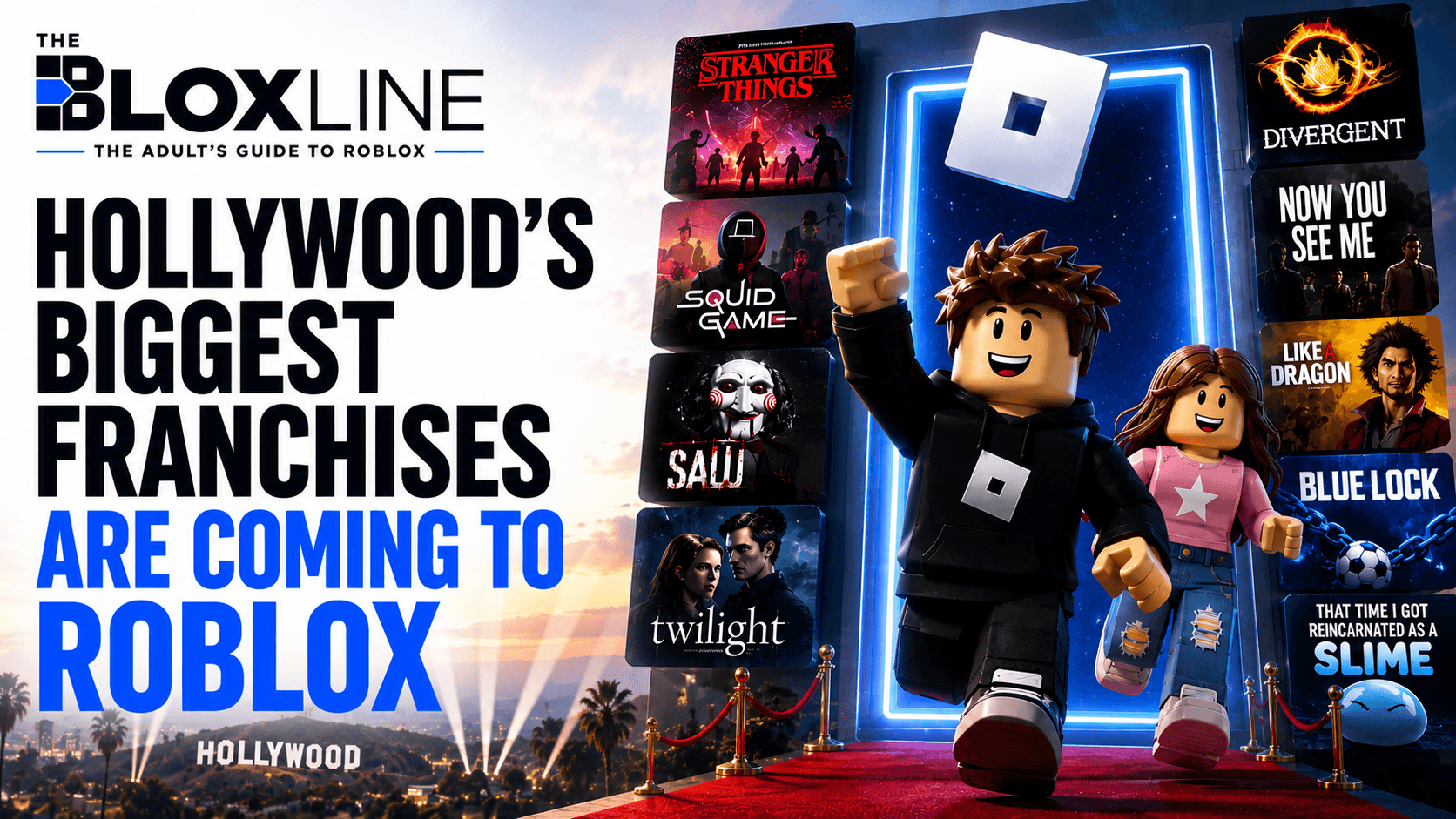
In July 2025, Roblox launched License Manager and the Licenses catalog, initially working with four major rights holders: Netflix, Lionsgate, Sega and Kodansha. The system gives eligible Roblox creators a formal route to discover intellectual property available for licensing and request permission to build games around it.
The first properties included some enormous entertainment names:
- Squid Game
- Stranger Things
- Twilight
- Saw
- Divergent
- Now You See Me
- Like a Dragon
The catalogue has continued expanding since then, including properties such as Blue Lock and That Time I Got Reincarnated as a Slime.
Then in 2026, Roblox expanded the idea again.
Creators can now find time limited IP licences, allowing licensed crossovers that can run from three days to three months.
For adults looking at Roblox from the outside, this might sound like a relatively technical developer update.
It isn't.
Roblox is building infrastructure that could change how major entertainment companies work with the developers creating games on its platform.
First, what exactly is IP?
IP stands for intellectual property.
In this context, think of it as the creative property behind a recognisable entertainment franchise.
Stranger Things is intellectual property.
Squid Game is intellectual property.
Twilight is intellectual property.
Blue Lock is intellectual property.
The characters, names, worlds, artwork and other protected elements belonging to these franchises cannot simply be used commercially by developers without the appropriate permission.
Roblox's licensing system does not remove that requirement.
It creates a structured way of obtaining that permission.
Creators can browse Roblox's Licenses catalog and request to use available IP. If permission is granted, they can build according to the conditions and revenue sharing arrangements established by the rights holder.
That distinction is important.
Roblox is not making Hollywood IP free for anybody to use.
It is making official licensing more accessible to eligible Roblox creators.
Roblox has effectively created a marketplace connecting IP owners and developers
This is where the idea becomes particularly interesting.
Rights holders can use Roblox's License Manager to define things including:
- Content standards
- Revenue sharing requirements
- Eligibility criteria
- Conditions governing how their IP can be used
Creators can then browse available licences and submit requests.
Think of it as a marketplace connecting two groups.
On one side are companies that own recognisable entertainment properties.
On the other are developers who know how to build Roblox games.
Roblox sits between them.
That potentially removes some of the friction that previously existed when a Roblox developer wanted to work with major intellectual property.
Roblox itself said when launching the system that traditional licensing negotiations could take months and were often inaccessible to smaller creators. Its goal was to make collaboration significantly faster and more scalable.
Some enormous entertainment properties are already involved
The original launch demonstrates the scale of Roblox's ambition.
Netflix brought Squid Game and Stranger Things into the initial catalogue.
Lionsgate contributed Twilight, Saw, Divergent and Now You See Me.
Sega brought Like a Dragon.
Kodansha subsequently added Blue Lock and That Time I Got Reincarnated as a Slime.
Mattel properties including Polly Pocket and Street Sharks later joined the catalogue as Roblox expanded self service licensing.
This is why it is useful to think about the development as bigger than simply "Hollywood coming to Roblox".
The ecosystem includes film, television, anime, gaming, toys and other forms of entertainment IP.
The real story is the infrastructure connecting those properties with Roblox developers.
Developers can now approach famous franchises with ideas
This changes an important part of the relationship between developers and rights holders.
Previously, a major entertainment company might decide it wanted a Roblox experience and then find a developer to create one.
That can still happen.
But the Licenses catalog creates another route.
A Roblox creator can discover an available property and request permission to build with it.
Roblox's documentation explicitly allows creators to browse the catalogue and request licences for available IP.
That means ideas can potentially originate from the developer side too.
And that matters because Roblox developers possess something entertainment companies may not.
They understand Roblox.
They understand what its players enjoy, how progression works, how communities develop, how games are discovered and what encourages people to return.
The entertainment company owns the characters and worlds.
The Roblox developer understands how to turn those things into a Roblox game.
The licensing platform gives those two sides a formal way to meet.
Famous characters don't automatically make a successful Roblox game
There is an important distinction here.
Having Stranger Things, Squid Game or another famous name attached to a game does not guarantee that Roblox players will enjoy it.
Roblox has developed its own gaming culture.
Successful games frequently understand things such as:
- Progression
- Social interaction
- Collecting
- Regular updates
- Customisation
- Events
- Rewards
- Retention
- Virtual economies
A beautifully produced game based on a famous franchise could still struggle if the actual game is not enjoyable.
That is one reason Roblox native developers could become increasingly valuable to entertainment companies.
Instead of simply asking:
How does an entertainment company build a Roblox game?
There is another question worth asking:
What could an experienced Roblox developer build with an entertainment company's characters and worlds?
We already have evidence this model can produce enormous games
One of the most interesting examples is Blue Lock: Rivals.
The experience uses Kodansha's Blue Lock intellectual property.
By November 2025, Roblox said Blue Lock: Rivals had already generated more than 4 billion visits.
Another licensed experience, The Squid Game by Mr Ducky Studio, had received more than 1.6 million favourites.
Roblox also said creators had submitted more than 1,500 licence requests across the available IP catalogue within the first months of the initiative.
Those numbers demonstrate that this isn't merely theoretical infrastructure waiting for developers to use it.
Developers are already interested.
Licensed games are already being created.
And some are already operating at enormous scale.
Time limited licences could make this much bigger
Roblox introduced another significant development in June 2026.
Time limited IP licences.
Instead of every licensing arrangement needing to produce a permanent game based around a franchise, eligible creators can find licences designed for temporary crossovers.
Roblox says these crossovers can run for between three days and three months.
That opens up a different type of opportunity.
The possibilities are easy to imagine.
A popular Roblox game could potentially host licensed content around a film release.
A horror experience could potentially run a crossover around Halloween.
An existing game could introduce temporary characters, worlds or items connected to an entertainment franchise.
These are examples of what the system could enable, rather than announced collaborations.
But the important distinction is that an entertainment company would not necessarily need to build an entirely new Roblox game every time it wanted to reach Roblox players.
It could potentially enter games where audiences already exist.
This starts to look a little like Fortnite, with one enormous difference
Adults familiar with Fortnite will recognise part of this strategy.
Fortnite has spent years bringing entertainment franchises, musicians, brands and famous characters into its ecosystem.
Those collaborations helped turn Fortnite into much more than a battle royale game.
But Roblox has an important structural difference.
Roblox isn't one game.
It is a platform containing millions of experiences built by different creators and studios.
That means Roblox's licensing opportunity could eventually become much more distributed.
A franchise does not necessarily have to appear inside one centrally controlled Roblox world.
Different developers could potentially build different experiences or licensed activations, depending on the licences available and the terms established by the rights holder.
Roblox could become part of the standard entertainment marketing calendar
This is where things become particularly interesting for entertainment companies.
Imagine a major film launching several years from now.
Its marketing campaign might include:
- Trailers
- TikTok
- YouTube
- Cinema advertising
- Influencer partnerships
- Merchandise
- Brand collaborations
- Television appearances
Roblox could increasingly sit alongside those channels.
But Roblox offers something fundamentally different.
The audience can participate.
Instead of simply watching an advert for a fictional world, players can potentially enter one.
Instead of seeing a character in a trailer, they can potentially interact with that character.
Instead of simply buying merchandise, they can potentially collect virtual items associated with the franchise.
That transforms Roblox from somewhere entertainment companies can advertise into somewhere their entertainment can become interactive.
A new business opportunity is emerging for Roblox studios
There is another side of this story that deserves attention.
Roblox studios do not necessarily have to limit themselves to creating original intellectual property.
Some could become specialists in adapting other companies' IP for Roblox.
The traditional games industry already works like this.
Different studios specialise in different things.
Roblox could eventually develop its own ecosystem of specialists.
One studio might become particularly good at adapting anime.
Another could specialise in horror.
Another could specialise in temporary brand events.
Another might build experiences connected to film releases.
Another could specialise in bringing licensed content into games that already have large audiences.
That potentially creates an entirely new category of Roblox business.
Smaller studios could find themselves working with enormous companies
This might be one of the most important consequences of the system.
The distance between a relatively small Roblox development team and a global entertainment company has historically been enormous.
But consider what some Roblox studios already possess.
They have games with millions of visits.
They understand young audiences.
They know Roblox culture.
They understand how to build for the platform.
Some already have enormous distribution.
That makes them potentially valuable partners.
Roblox's licensing infrastructure doesn't mean every small developer can suddenly work with Netflix, Lionsgate or another major rights holder. Eligibility requirements still apply, licence requests can be rejected and developers must comply with the terms of any licence they receive.
But there is now a formal route through which those relationships can potentially begin.
That is significant.
Rights holders get something important too: control
Why would entertainment companies want this?
One answer is control.
Rights holders can establish the standards governing how their intellectual property is represented.
Roblox's License Manager allows them to define content standards, eligibility criteria and revenue sharing requirements.
That creates a middle ground.
A company doesn't necessarily have to build every Roblox experience itself.
But it also doesn't have to simply watch unofficial uses of its characters spread across the platform.
It can make selected IP available under defined conditions and allow approved creators to build with it.
That could make Roblox significantly more attractive to companies that previously viewed user generated gaming platforms as difficult environments in which to protect their brands.
Famous franchises could make Roblox easier for adults to understand
There is another interesting consequence.
Someone unfamiliar with Roblox may have absolutely no idea what many of its biggest native games are.
But they may know Stranger Things.
They may know Squid Game.
They may know Twilight.
They may know Blue Lock.
Recognisable franchises can therefore become bridges into Roblox.
An adult who would never search for an unfamiliar Roblox experience might be curious enough to explore something connected to entertainment they already understand.
That could become increasingly important as Roblox tries to broaden the types of people who use the platform.
But famous IP still doesn't guarantee a successful game
There is one major warning.
Licensing can create attention.
It cannot manufacture a good game.
The wider games industry has decades of examples of licensed games that failed despite having enormous franchises attached to them.
Roblox will not automatically escape that problem.
A successful licensed Roblox game still needs good gameplay.
It still needs progression.
It still needs reasons to return.
It still needs developers who understand the audience.
A recognisable franchise might convince somebody to click Play.
The game itself has to convince them to play again tomorrow.
This is part of a much bigger Roblox ambition
There is a wider strategy behind all of this.
Roblox has set an extraordinarily ambitious goal: it wants 10% of global gaming content revenue to eventually flow through the Roblox ecosystem.
Licensing makes much more sense when viewed through that lens.
Roblox wants more professional creators building businesses on the platform.
It wants more major entertainment properties.
It wants deeper connections with the wider gaming and entertainment industries.
And it wants its developer ecosystem to participate in that growth.
Making it easier for those developers to work with established intellectual property fits directly into that ambition.
The Bloxline view
The most important part of this story isn't Stranger Things.
It isn't Squid Game.
It isn't Blue Lock.
It's the connection Roblox is building between intellectual property owners and its developer ecosystem.
On one side are companies sitting on decades of characters, stories, films, television programmes, anime, games and brands.
On the other are developers who understand how to build interactive experiences for Roblox audiences.
Historically, connecting those two groups could be difficult.
Roblox is trying to build infrastructure between them.
That could eventually change the question entertainment companies ask.
Instead of:
"Should we build a Roblox game?"
The question could increasingly become:
"Which Roblox developers should we let build with our IP?"
And some of the most interesting answers may come from studios the traditional entertainment industry barely knows today.
That is why this development matters.
Roblox isn't simply bringing famous franchises onto its platform.
It is creating a more accessible system through which eligible developers can officially build with them.