Roblox Studio Is Starting to Let Developers Sculpt Complex 3D Objects Instead of Building Everything From Parts
Roblox Studio is improving its 3D modelling tools, giving developers more ways to create complex shapes and showing how the platform is becoming more sophisticated.
For a long time, one of the easiest ways to understand how Roblox games were built was to imagine somebody constructing a world from lots of individual pieces, with walls, floors, roads, rocks and other objects being placed together until they eventually formed the environment players could explore.
That description is becoming increasingly outdated.
Roblox has been steadily making Studio, the software developers use to build Roblox experiences, more sophisticated, and one of the areas it is improving is solid modelling, which essentially gives developers more freedom to take 3D objects and cut, combine or reshape them rather than having to create complicated structures from lots of separate pieces.
For somebody who has never made a game, terms such as meshes, geometry and solid modelling can make this sound far more complicated than it needs to be.
The important thing to understand is simple.
Roblox wants developers to have better tools for shaping the actual 3D worlds they build.
What exactly is changing in Roblox Studio?
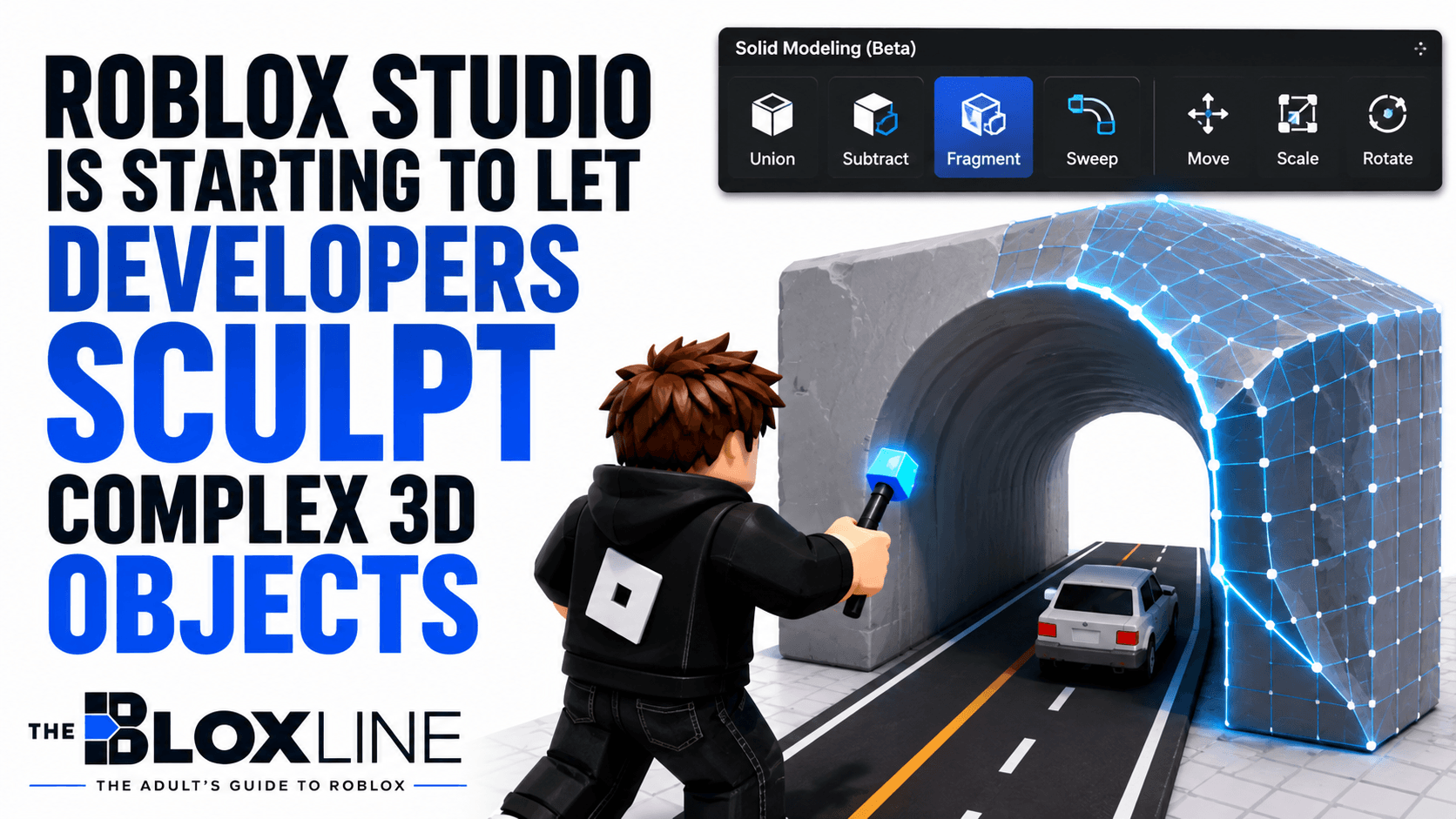
Roblox has been developing new solid modelling capabilities that can work with meshes, alongside tools including Fragment and Sweep, which give developers additional ways of creating and manipulating 3D shapes.
That probably means very little if you have never opened a piece of 3D modelling software, so it is easier to think about what developers might actually want to accomplish.
Imagine somebody has created a large piece of rock and wants to build a tunnel through it.
One approach would be to construct the rock from many individual pieces while deliberately leaving enough space in the middle for players to walk through, but that can quickly become awkward, particularly when the developer wants the finished environment to look natural rather than like something assembled from blocks.
A modelling tool can instead make it possible to work much more directly with the shape itself.
The same principle could apply to creating unusual buildings, pipes, roads, caves, machinery or countless other objects that do not fit neatly into simple squares and rectangles.
The technical details become considerably more complicated once developers start using these systems professionally, but for an adult simply trying to understand what Roblox is changing, the important point is that developers are gaining more control over the shapes that make up their worlds.
First, what is a mesh?
You will see the word "mesh" frequently when reading about modern game development, but the basic idea is straightforward.
A mesh is essentially the three dimensional shape of an object.
The body of a car can be a mesh.
A detailed rock can be a mesh.
A chair, tree, statue, weapon, building decoration or piece of machinery can all be represented using meshes.
Simple Roblox experiences can still be created using basic parts such as blocks, cylinders and spheres, but as developers try to make their games more visually detailed, they increasingly need objects that have more complicated shapes.
That is where meshes become important.
If Roblox Studio becomes better at allowing developers to manipulate those kinds of objects directly, creators gain more flexibility over what they can build without necessarily having to solve every problem somewhere outside Roblox.
What does solid modelling actually mean?
Solid modelling sounds like something that requires an engineering degree to understand, but the basic concept can be explained with children's building blocks.
Imagine placing two blocks together and turning them into one object.
That is one type of operation.
Now imagine taking a smaller block, pushing it through a larger block and using it almost like a cookie cutter so that a hole remains where the smaller block used to be.
That is another.
Game developers can use variations of these ideas to produce considerably more complicated objects, because once shapes can be combined, separated and cut into different forms, the developer is no longer limited to arranging basic pieces next to one another.
They can start sculpting the environment itself.
That is why these improvements matter.
It is not necessarily about giving every Roblox developer a button labelled "make better graphics".
It is about expanding the collection of tools developers have available when they encounter a difficult 3D problem.
Fragment and Sweep sound complicated, but the ideas are understandable
Two names appearing alongside Roblox's newer solid modelling work are Fragment and Sweep.
Again, the names are more intimidating than the underlying ideas need to be for somebody outside game development.
Fragment is concerned with breaking geometry into separate pieces, which potentially gives developers more flexibility when they need an object to be divided or processed in different ways.
Sweep, meanwhile, is easier to picture if you imagine drawing a path and then extending a shape along that path.
Think about a pipe.
Instead of manually placing lots of small cylindrical pieces and rotating every one until they eventually form a curve, a developer could define the route the pipe should follow and use modelling techniques to create geometry along it.
The same broad idea could potentially be useful for curved structures, tubes and other objects that follow a particular route.
For professional developers, the interesting part is obviously what these tools allow technically.
For everyone else, the important takeaway is much simpler: Roblox Studio is gaining more ways to create complicated shapes without developers having to construct everything manually from dozens of individual objects.
Why not just build everything in Blender?
This raises an obvious question.
Professional Roblox developers already have access to powerful dedicated 3D software, including applications such as Blender, so why does Roblox need to improve modelling inside Studio at all?
Because moving constantly between different pieces of software creates work.
A professional Roblox studio might use specialist software to create detailed characters, buildings, vehicles and other assets before bringing those objects into Roblox Studio, and there is nothing inherently wrong with that workflow because specialist 3D applications will continue to provide capabilities far beyond what a game engine needs to contain.
The problem comes when developers need to make changes.
An object might not quite fit the environment.
A designer might discover that a doorway needs to be wider.
A structure might need another opening.
Something that looked good in the modelling software might not work properly once real players start interacting with it.
If every meaningful adjustment requires somebody to leave Studio, open another application, change the asset, export it again, import it again and test it again, those small changes can gradually create a lot of friction.
The more Roblox allows developers to solve problems directly inside Studio, the faster some of those development loops can potentially become.
Roblox Studio is becoming much more than a place for assembling blocks
This is the bigger story.
It would be easy to look at an update involving solid modelling and assume it only matters to the relatively small number of people who understand 3D geometry.
But individual developer updates tell us something much larger when viewed together.
Roblox Studio is gradually becoming a more capable game development environment.
That distinction matters because Roblox has ambitions far beyond being the place where relatively simple children's games are created.
The platform wants developers to build larger, better-looking and more technically sophisticated experiences, and achieving that requires Roblox to improve not only what players see when they open the app, but also the software developers use months or years before those players ever arrive.
Better development tools raise what creators can realistically attempt.
This matters if Roblox wants more professional studios
There is an enormous difference between somebody experimenting with Roblox Studio after school and a professional team with artists, programmers, designers and producers trying to operate a business.
Professional studios care about how quickly their teams can work.
They care about how easily assets can be changed.
They care about how many different pieces of software are required to complete a task.
They care about whether artists and designers can iterate quickly when something is not working.
They also care about whether the engine itself becomes the thing preventing them from creating what they originally imagined.
That means Roblox's competition for professional developers is not simply about offering a huge audience or providing ways to make money.
The development environment has to be good enough too.
Every time Roblox makes Studio more capable, it removes another small reason for an experienced developer to think of the platform as technically restrictive.
No single modelling feature will suddenly persuade the entire traditional games industry to start building on Roblox, but the accumulation of these improvements is much more significant.
There is an education story here as well
These tools also make Roblox interesting from an educational perspective because young people who begin building Roblox experiences are increasingly being introduced to concepts that exist throughout professional game development.
A child might begin by placing a few blocks into Studio and creating a simple obstacle course.
Later they might learn scripting.
Then animation.
Then lighting.
Then user interface design.
Then meshes, modelling, procedural generation and optimisation.
At that point, what began as playing around inside Roblox has become an introduction to several different areas of digital production.
The exact Roblox tools may change over time, but many of the underlying ideas do not disappear when somebody leaves Roblox.
Understanding how 3D objects are constructed, how environments are designed and how technical limitations influence creative decisions are useful concepts across games, animation, visual effects and other digital industries.
That does not mean learning Roblox Studio automatically turns somebody into a professional game developer.
It does mean the distance between "I make things in Roblox" and "I am learning how digital worlds are built" is becoming increasingly small.
Better tools can eventually mean better Roblox games
Players may never know that a particular tunnel, building or environment was made possible by an improvement to Roblox Studio.
They probably should not have to.
The best development tools often disappear into the finished product.
What players eventually notice is that environments become more detailed, developers attempt more ambitious ideas and studios can spend less time fighting technical limitations.
This is why seemingly boring Studio updates can matter enormously.
The Roblox experience somebody plays two years from now may be possible because of development tools being introduced today.
Roblox has to improve both sides of the platform
Most discussion around Roblox's growth naturally focuses on players.
How many people use Roblox?
How old are they?
How much money are they spending?
Which games are becoming popular?
Those are important questions, but Roblox effectively has two groups it needs to keep convincing.
It needs players to continue showing up.
And it needs developers to continue believing Roblox is worth building for.
The second part becomes even more important as the platform tries to attract ambitious studios that could otherwise build games for PC, console or mobile.
Those developers will compare Roblox Studio with the tools available elsewhere.
They will notice what it can do.
They will also notice what it cannot do.
Improving solid modelling is therefore part of a much larger battle to make Roblox Studio capable enough that developers can concentrate on what they want to create rather than constantly thinking about what the platform will allow them to create.
Roblox Studio's evolution tells us where Roblox wants to go
There is still an enormous range of experiences on Roblox, from projects made by individual hobbyists to games operated by organised studios with substantial teams and millions of players.
Roblox needs Studio to accommodate that entire spectrum.
The beginner should still be able to place a block into an empty world and immediately understand what is happening.
At the same time, an experienced development team needs increasingly sophisticated tools that allow it to create something far beyond those basic blocks.
That is a difficult balance.
But improvements to meshes and solid modelling show the direction of travel.
Roblox is not abandoning the simplicity that allowed millions of people to start creating.
It is attempting to raise the ceiling above them.
And that may ultimately be more important than any single new modelling feature.
Because if Roblox wants its games to become more sophisticated, its developers first need more sophisticated ways to build them.