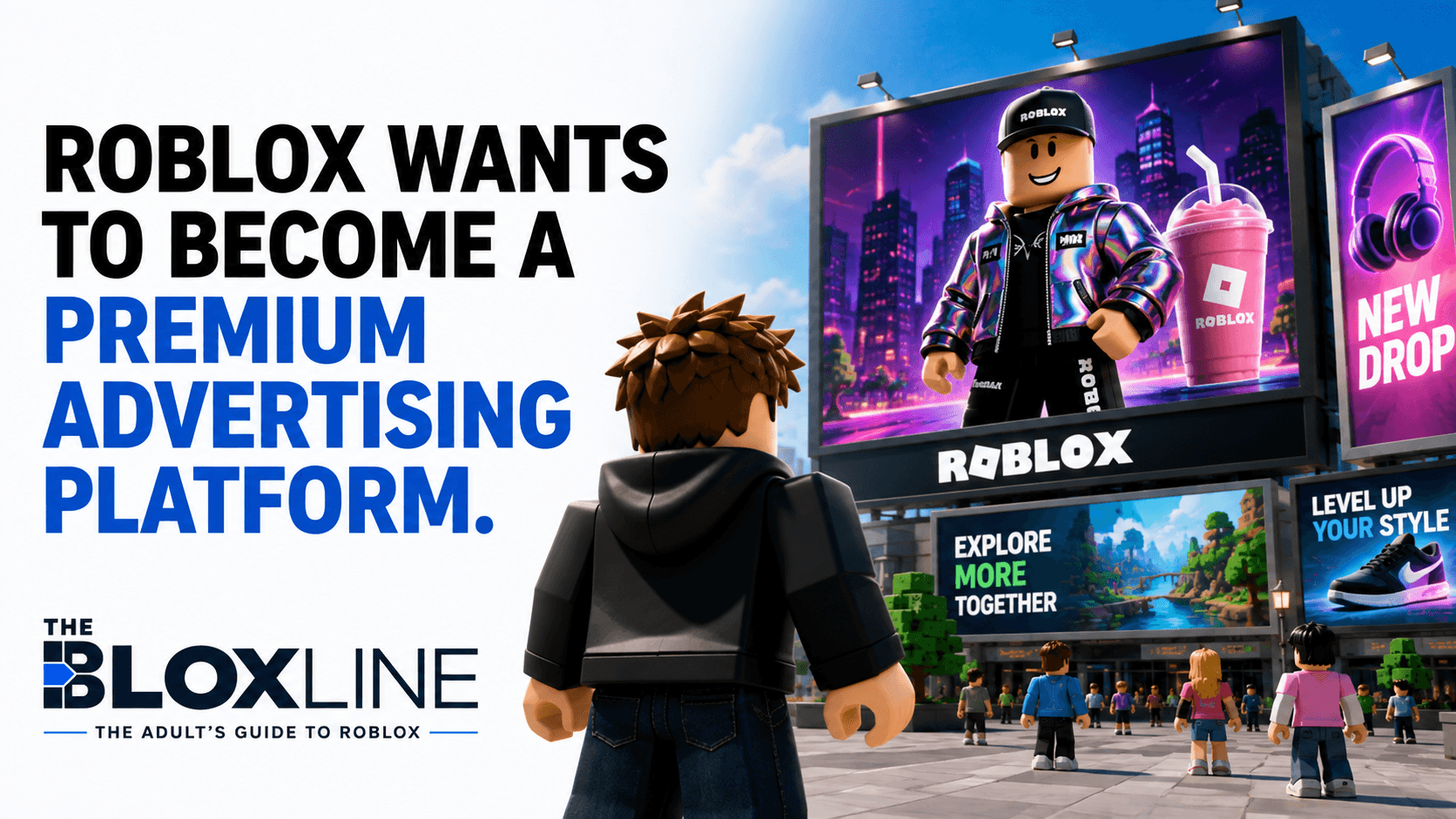
Roblox Wants to Become a Premium Advertising Platform. Here’s Why Brands Should Pay Attention
For years, when businesses thought about advertising to young audiences online, the obvious platforms were places such as YouTube, TikTok and Instagram.
Roblox increasingly wants to be part of that conversation.
The company is building an advertising business that looks much more like the infrastructure marketers already understand. Brands can buy video advertising, premium homepage placements and ads inside Roblox experiences. Programmatic buying is available through major advertising platforms, while measurement companies including Nielsen, Kantar, Integral Ad Science and DoubleVerify can help advertisers understand whether campaigns actually worked.
The important change is that a company no longer necessarily needs to spend months building an elaborate branded Roblox world before it can advertise on the platform.
Roblox is trying to make advertising on Roblox feel increasingly like buying advertising anywhere else.
For adults trying to understand where Roblox is heading as a business, that matters enormously.
Roblox is no longer only selling virtual worlds to brands
Brands have experimented with Roblox for years.
The most visible examples usually involved companies creating dedicated experiences or collaborating with developers to put branded items and environments inside existing games.
Those projects can be impressive, but they also create friction.
A company needs developers. It needs a concept. It needs assets. It needs to understand Roblox. Then it needs to convince people to actually visit the experience.
That makes Roblox considerably more complicated than simply buying an advertising campaign on another digital platform.
Roblox's expanding advertising system is designed to reduce that barrier.
Its current advertising offering includes video advertising, homepage placements, search and discovery placements, and advertising integrated directly into Roblox experiences.
That potentially opens Roblox to a much larger advertising market.
The Roblox homepage is becoming premium advertising space
One of the clearest examples is Roblox's Homepage Feature.
Roblox introduced the format in January 2026 as a premium advertising product appearing directly on its homepage. The company described the homepage as the starting point for more than 151 million daily users at the time of the announcement.
The interesting part is what happens after somebody clicks.
Instead of simply sending the player to a conventional webpage, Roblox can transform a brand's existing video creative into an immersive 3D environment.
That means a marketer can potentially provide assets it already has rather than commissioning an entirely new Roblox experience.
Early tests included e.l.f., Sam's Club and Universal Pictures' Five Nights at Freddy's 2.
Roblox now also advertises a Homepage Hero, a premium above the fold placement that can dominate the homepage for 24 hours and is positioned specifically for major launches.
Think about what Roblox is trying to create here.
A film studio launching a blockbuster, a games company launching a new title or a consumer brand launching a major product could potentially treat the Roblox homepage as premium media inventory.
That is a significant evolution from thinking of Roblox primarily as somewhere brands build virtual worlds.
Roblox has something advertisers desperately want: attention
Advertising ultimately follows attention.
Roblox has an extraordinary amount of it.
Millions of people do not simply open Roblox, glance at a feed for several minutes and leave. They enter experiences and spend significant periods actively playing.
That creates an interesting advertising environment.
A billboard inside a Roblox city is not competing with 15 other posts on a scrolling social feed.
It exists inside the environment the player is exploring.
Roblox says its Billboard Video and display advertising can be integrated into high-traffic areas inside popular games, with packages offering more than 70% viewability.
But perhaps its most interesting format is one where the player actively chooses to see the advertisement.
Roblox is making people choose to watch adverts
Rewarded Video works on a simple exchange.
A player is offered something useful inside a game.
Perhaps currency.
Perhaps an item.
Perhaps another in game benefit.
To receive it, they voluntarily watch an advertisement.
The videos can last between six and 30 seconds. Roblox says its current Rewarded Video advertising achieves approximately 90% completion rates and 95% viewability.
That is very different from interrupting somebody's game with an unavoidable commercial.
The player makes a choice:
my attention is worth this virtual reward.
For advertisers, that potentially creates unusually deliberate attention.
For developers, it creates another source of revenue.
And for players, the advertisement provides something tangible in return.
Why developers should care about Roblox advertising
This advertising strategy is not only about Roblox making more money.
Roblox needs its developers to benefit too.
Developers can incorporate Rewarded Video into eligible experiences and choose the in-game reward players receive after watching. Roblox specifically says the system is intended to help creators monetise more users and increase advertising revenue per player.
This matters because not everyone who plays Roblox buys Robux.
Imagine a successful free Roblox game with one million players.
Perhaps only a fraction purchase virtual items.
Advertising potentially gives the developer another way to make money from everyone else without forcing them to spend.
That is an economic model already familiar across mobile gaming.
Roblox is bringing more of it into its creator economy.
Google makes this much bigger
Roblox's advertising ambitions become more significant when you look at how brands can buy the ads.
In 2025, Roblox announced a partnership with Google that made Rewarded Video available through Google's advertising technology as well as through direct buying.
Roblox's current advertising offering also provides programmatic access through systems including Display & Video 360, Magnite and Index Exchange.
This sounds technical, but the significance is simple.
A brand should not need to completely reinvent how its marketing department buys advertising just because it wants to reach Roblox.
Roblox wants to appear inside the systems advertisers already use.
That is how Roblox advertising can move from an experimental marketing budget to a normal media budget.
Measurement may be even more important than the ads
Large advertisers want evidence.
It is not enough for a Roblox activation to look impressive in a presentation.
Marketing departments need to answer questions such as:
How many people actually saw it?
Did the right people see it?
Did they remember the brand?
Did the campaign change how they thought about the brand?
Did it influence purchasing behaviour?
Roblox is therefore working with established advertising measurement companies.
Its current advertising offering includes audience verification through Nielsen and iSpot.tv, business outcome measurement through Kantar and Cint, and verification and brand suitability tools involving IAS and DoubleVerify.
That may sound less exciting than a spectacular branded Roblox world.
Commercially, however, it could be much more important.
Advertising markets scale when buyers can measure what they are purchasing.
Roblox is also changing the rules around advertising
There is another side to this story.
As advertising becomes a more important part of Roblox, the company is becoming more formal about what constitutes advertising.
From May 2026, Roblox expanded and clarified its advertising policies. Content can be classified as advertising when a brand compensates a creator to feature it inside an experience or when it promotes products outside Roblox.
Roblox also introduced clearer age-appropriate advertising standards.
Advertising integrations, homepage formats and billboard ads can now be shown across different age categories, including users under 13, provided the advertising complies with Roblox's age-appropriate requirements.
That distinction is particularly important because Roblox's audience includes children.
A successful advertising business cannot simply maximise the number of adverts shown.
It also needs parents, regulators and advertisers to trust where those adverts appear.
Roblox is building advertising infrastructure, not simply selling ads
This is the larger story.
Look at the pieces together.
Roblox has premium homepage inventory.
It has video advertising.
It has rewarded advertising.
It has in-world advertising.
It has programmatic buying.
It has advertiser targeting.
It has independent measurement.
It has brand-suitability systems.
It has advertising policies.
And it has millions of developers capable of creating environments where those advertisements can appear.
That starts to look less like an experimental gaming advertising product.
It starts to look like an advertising platform.
The comparison with YouTube is worth watching
Roblox and YouTube are obviously very different products.
But there is an interesting similarity in their economics.
YouTube did not simply build an enormous audience.
It created an ecosystem where creators produce the content, audiences consume that content, advertisers pay to reach those audiences, and some of that advertising money flows back to creators.
Roblox potentially has the ingredients for a similar flywheel.
Developers build games.
Players spend time inside them.
Brands pay to reach those players.
Developers earn advertising revenue.
More money encourages developers to build better games.
Better games attract more players.
More players make Roblox more valuable to advertisers.
That cycle could become an increasingly important part of Roblox's business.
There is also a major opportunity around older users
Roblox's push toward older audiences matters here too.
The platform already allows programmatic targeting of its 18+ advertising inventory, while contextual targeting is available across eligible users aged 13 and above.
As Roblox's adult audience grows, its advertising proposition changes.
A platform predominantly associated with children creates obvious limitations for advertisers.
A platform containing tens of millions of teenagers and adults alongside younger users becomes commercially much broader.
Cars.
Financial services.
Technology.
Entertainment.
Travel.
Consumer electronics.
Fashion.
Restaurants.
Sports.
Many categories become more interesting as Roblox's audience ages.
This is another reason the demographic transformation of Roblox matters commercially.
Brands may eventually advertise on Roblox without thinking of it as a Roblox campaign
That could be the real milestone.
Today, a brand advertising on Roblox often treats it as something special.
There might be a dedicated Roblox strategy.
A specialist agency.
A custom experience.
A press release announcing the activation.
But mature advertising platforms eventually become boring.
A marketer does not issue a press release every time they purchase YouTube inventory.
They simply include YouTube in the media plan.
Roblox's advertising business succeeds at scale when the same thing happens.
A brand launching a film, trainer, phone or new product simply selects Roblox alongside the other places where its audience spends time.
At that point, Roblox stops being an experimental advertising channel.
It becomes part of mainstream media.
What this means for adults watching Roblox
Roblox's advertising push tells us something important about what the company believes it is becoming.
It does not want to make money only when players buy Robux.
It wants to monetise attention itself.
That puts Roblox into competition for advertising budgets that historically flowed toward television, YouTube, social networks, mobile games and other digital platforms.
And unlike most of those platforms, Roblox has another advantage.
Its users are not simply watching content.
They are inside it.
For brands, the difference between advertising beside entertainment and advertising inside an interactive world could become increasingly important.
The Bloxline view
Roblox's advertising opportunity is not simply that it has a lot of users.
Plenty of platforms have large audiences.
The interesting part is that Roblox controls three things simultaneously:
the audience, the entertainment environment and the creator economy producing that environment.
If Roblox can connect those three successfully, advertising could become another engine for the entire ecosystem.
Brands get attention.
Roblox gets advertising revenue.
Developers get another way to earn.
Players potentially get more free content and rewards.
That is why Roblox's move into premium advertising deserves attention well beyond the advertising industry.
It is another step toward Roblox becoming not simply somewhere people play games, but a major media platform.