Major PC and Mobile Games Are Coming to Roblox. Here’s Why That Matters
For years, Roblox has largely been associated with games that started on Roblox.
Experiences such as Brookhaven, Adopt Me!, Blox Fruits and Murder Mystery 2 became enormous because developers built them specifically for the platform and Roblox players turned them into hits.
But something interesting is beginning to happen in the opposite direction.
Established games from outside Roblox are starting to move in.
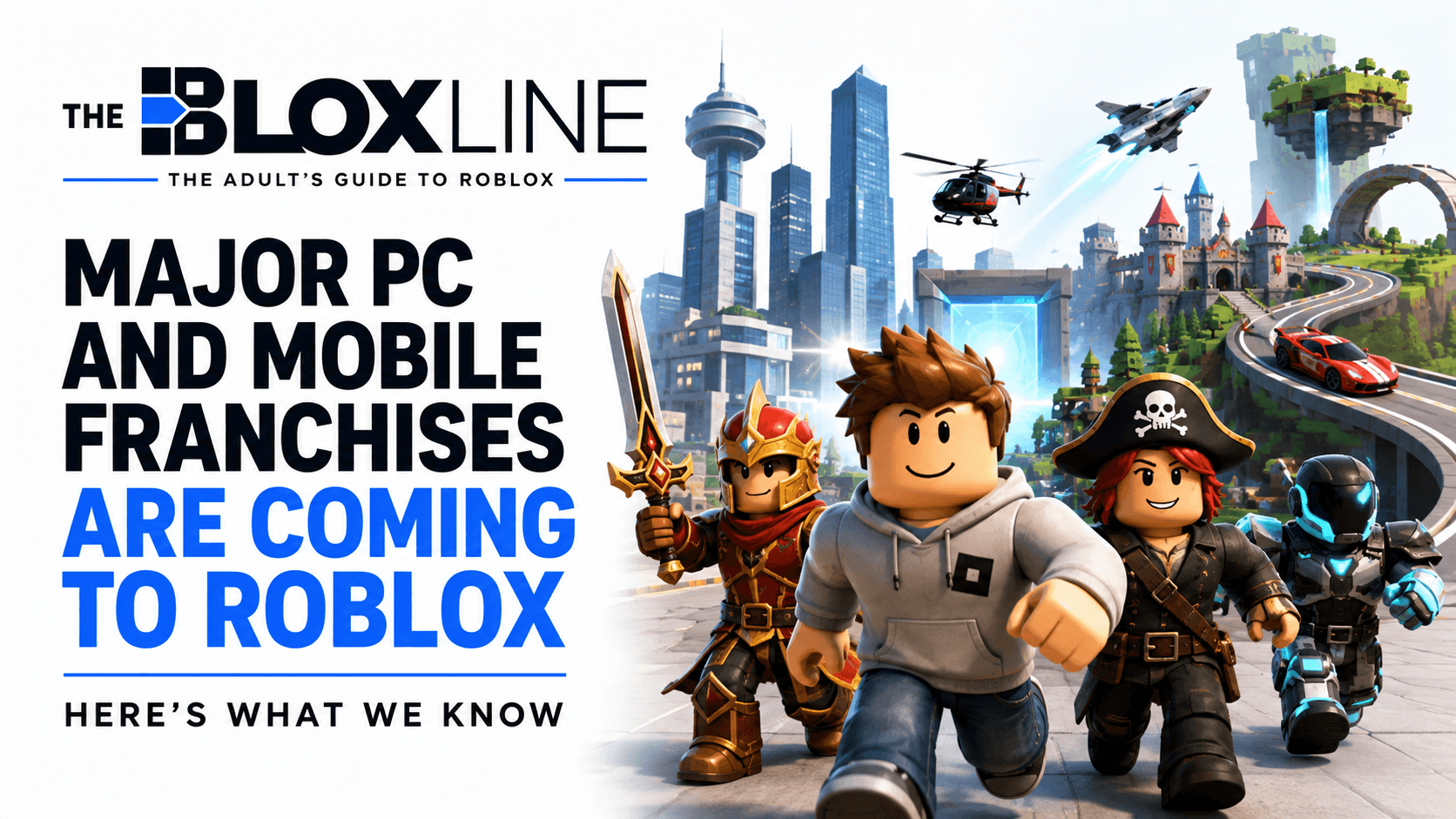
Roblox revealed during its 2026 financial reporting that it is working with established game studios to bring reimagined versions of well-known PC and mobile games onto Roblox.
The company has not yet publicly named all of the games involved.
But Roblox has indicated that the franchises currently being worked on collectively reach more than 150 million monthly players outside Roblox.
That number is important.
These are not necessarily tiny games looking for their first audience.
Roblox is trying to persuade established parts of the traditional games industry that Roblox can become another place for their games to exist.
And if that strategy works, it could significantly change what Roblox looks like over the next few years.
Roblox wants games people already know
The easiest way to understand this strategy is to think about how Roblox has traditionally worked.
A developer builds something.
They publish it on Roblox.
Players discover it.
If everything goes incredibly well, the game grows into a recognisable Roblox franchise.
Roblox's new strategy introduces another possibility.
Start with a game that already has an audience elsewhere.
Then build a version designed specifically for Roblox.
That means someone who already plays a particular game on PC or mobile could eventually find a Roblox interpretation of something they recognise.
For Roblox, that solves an important problem.
It doesn't have to introduce that player to an entirely unfamiliar game.
The game itself can become the reason they try Roblox.
These aren't necessarily going to be simple ports
The word “reimagined” matters.
Adults familiar with gaming might hear this news and imagine developers simply uploading their existing mobile or PC games to Roblox.
That isn't really how Roblox works.
Roblox experiences are built using Roblox's own technology and operate inside its wider platform.
Players use Roblox accounts.
Games run across devices supported by Roblox.
Social systems are integrated into the platform.
Developers can use Roblox's economy.
Discovery happens largely through Roblox.
Characters and virtual items can interact with the wider ecosystem in ways that conventional standalone games cannot.
So bringing an existing franchise to Roblox is likely to involve asking a different question:
What would this game look like if it had originally been designed for Roblox?
That could produce something substantially different from the original.
Roblox is doing more than simply opening the door
Another important part of this story is Roblox's involvement.
The company isn't simply telling traditional studios:
“Roblox Studio is available. Good luck.”
Roblox has discussed supporting these projects with areas including game design, development, audience acquisition and co-investment.
That is significant.
Roblox clearly wants these games to succeed.
It suggests the company sees traditional gaming franchises as strategically important enough to actively help bring them onto the platform.
Why would an established game studio want to build on Roblox?
This is perhaps the more interesting question.
If a studio already has a successful PC or mobile game, why bother rebuilding it for Roblox?
The simplest answer is:
players.
Roblox provides access to a huge existing gaming audience.
A conventional game developer normally needs to think about many different parts of bringing a game to market.
Distribution.
Accounts.
Payments.
Multiplayer infrastructure.
Discovery.
Social systems.
Device compatibility.
Community.
Roblox already provides much of that underlying infrastructure.
The developer can build inside an ecosystem where the audience already exists.
That doesn't guarantee success.
But it changes the proposition considerably.
Think of Roblox as a platform, not an individual game
This is where adults unfamiliar with Roblox sometimes misunderstand what it is.
Roblox is not one enormous game.
It is closer to an ecosystem containing millions of games and experiences.
That distinction makes this strategy easier to understand.
A studio does not necessarily need to see Roblox as a competitor to its game.
It can see Roblox as another place to distribute that game or its IP.
There is already precedent for this way of thinking across entertainment.
A film franchise can have:
films,
television shows,
mobile games,
console games,
merchandise,
theme park attractions,
and Roblox experiences.
Gaming franchises can increasingly work the same way.
The Roblox version becomes another expression of the IP.
But Roblox wants something more ambitious than branded experiences
Brands have been appearing on Roblox for years.
Nike, Gucci, Walmart and entertainment companies have experimented with Roblox worlds, virtual items and events.
But there is an important difference between:
“Our brand has a Roblox experience.”
and:
“Our actual game franchise now has a Roblox version.”
The second moves Roblox closer to the traditional games industry.
A marketing activation might exist for several months around a product launch.
A properly supported game can potentially exist for years.
It can receive updates.
Build a community.
Generate revenue.
Develop its own Roblox player base.
And perhaps become a meaningful part of the wider franchise.
That's much more consequential.
Roblox is also trying to attract older players
There is another reason this strategy makes sense.
Roblox increasingly wants more adults playing Roblox.
The platform grew up with a strong association with children, partly because so much of its historic audience was young.
But those players are ageing.
At the same time, Roblox is actively encouraging developers to build genres that traditionally appeal to older gamers.
That includes areas such as:
RPGs,
strategy games,
shooters,
sports,
racing,
and more sophisticated competitive experiences.
Established PC and mobile franchises could accelerate that process.
Imagine someone in their twenties who has never considered playing Roblox.
They see an unfamiliar Roblox game.
They probably ignore it.
Now imagine they see a game based on a franchise they've played for five years.
Suddenly Roblox has a reason to enter their gaming rotation.
The franchise becomes the bridge.
150 million existing players makes this particularly interesting
The scale of the franchises Roblox says it is working with deserves attention.
Collectively, Roblox says the games involved have audiences exceeding 150 million monthly players on other platforms.
That does not mean 150 million people are about to join Roblox.
Far from it.
There will also likely be significant overlap between those audiences.
But it tells us something about Roblox's ambitions.
It isn't simply experimenting with obscure intellectual property.
It is working with games that already have meaningful audiences.
That means Roblox isn't only trying to create its next generation of hits internally.
It is also trying to import existing gaming culture into the platform.
What games are actually coming?
This is the obvious question.
At the moment, Roblox has not publicly revealed the complete list of franchises involved in this initiative.
That means speculation should be treated carefully.
There will inevitably be guesses about which PC and mobile games would make sense.
But until Roblox or the studios themselves announce them, they remain guesses.
What we do know is more interesting anyway.
Multiple projects are being developed.
They involve established PC and mobile games.
They collectively have a very large existing audience.
And Roblox is actively helping make them happen.
The Bloxline will update this article as the individual franchises are revealed.
This could be a big opportunity for traditional studios
There is a broader games-industry question here.
Traditionally, a studio deciding where to launch a game might think about:
- PC.
- PlayStation.
- Xbox.
- Nintendo.
- iOS.
- Android.
Different platforms come with different audiences, economics and technical requirements.
Roblox increasingly wants to enter that conversation.
Not necessarily as a replacement for those platforms.
But as another option.
A studio might eventually think:
We have millions of players on mobile. What would a Roblox version look like?
That question becomes particularly interesting for games with:
- strong communities
- customisation
- collecting
- social gameplay
- persistent progression
- younger audiences
- user generated elements.
Some games will translate much better than others.
It could also change competition inside Roblox
There is another side to this story.
Roblox-native developers have spent years learning how the platform works.
They understand Roblox players.
They understand discovery.
They understand Roblox Studio.
They understand monetisation.
They understand how Roblox communities behave.
Those skills have helped create a new generation of professional Roblox studios.
Now imagine established games companies entering the same market.
They may bring:
- experienced developers
- existing IP
- marketing budgets
- professional production pipelines
- millions of existing fans
Competition could increase considerably.
But Roblox native developers also have something traditional studios do not automatically possess.
Roblox expertise.
That could create partnerships.
A conventional studio with a famous game may understand its franchise extremely well but have little experience building for Roblox.
A Roblox studio may understand the platform incredibly well but lack recognisable global IP.
Put those two together and you have an interesting new business model.
Roblox studios could become adaptation specialists
This is one area worth watching particularly closely.
Some Roblox studios may increasingly specialise in helping outside companies enter Roblox.
We've already seen studios build experiences for brands.
The next step could be more sophisticated.
Instead of:
“Build our company a Roblox marketing experience.”
the brief becomes:
“Take our successful game and turn it into a successful Roblox game.”
That requires much deeper expertise.
The studio needs to understand what makes the original game special while also understanding what Roblox players expect.
That is valuable knowledge.
It could create an entirely new category of professional Roblox studio.
There is a big difference between bringing players in and keeping them
Established IP provides an advantage.
It creates recognition.
But recognition alone does not make a successful Roblox game.
Players still need to enjoy the experience.
They need reasons to return.
The game needs to understand Roblox's discovery environment.
It needs to work across the devices Roblox players use.
Its monetisation needs to make sense.
Its updates need to maintain interest.
A famous name may generate the first click.
The game still has to earn the second session.
That will be the real test of this strategy.
What does this mean for parents?
For parents, this development is another sign that the Roblox their children use today may look very different in several years.
The platform is becoming broader.
Roblox native games will remain enormously important.
But they may increasingly sit alongside recognisable franchises from elsewhere in gaming.
That could also create an interesting reversal.
Right now, parents often discover Roblox games because their children introduce them.
In future, children may discover franchises because their parents recognise them from outside Roblox.
Roblox becomes another place generations of gaming culture can meet.
What does this mean for investors?
For investors watching Roblox, the strategy connects to one of the company's biggest ambitions.
Roblox wants to become a much larger part of the global games market.
Doing that entirely through newly created Roblox-native games would be difficult.
Established franchises offer another route.
They bring audiences.
They bring recognition.
They bring experienced studios.
And potentially they bring older players.
If successful, this strategy could strengthen the argument that Roblox is not simply a collection of children's games.
It is becoming gaming infrastructure.
The bigger battle is for developers
The traditional games industry has several major engines and distribution ecosystems.
Developers build with technologies such as Unity and Unreal Engine.
They distribute through places such as Steam, consoles and mobile app stores.
Roblox operates differently because creation, distribution, identity, social systems and monetisation all sit inside one ecosystem.
That creates limitations.
Developers have less independence than they would building a completely standalone game.
But it also creates enormous convenience.
Roblox is effectively saying:
Build here and we'll provide much of the world around your game.
The more successful traditional studios become on Roblox, the stronger that proposition becomes.
The Bloxline View
The most interesting part of this story isn't that familiar games are coming to Roblox.
We've already seen plenty of famous intellectual property appear on the platform.
The bigger development is what Roblox wants those companies to believe.
Roblox wants game studios to see it as somewhere their games can actually live.
That is different from advertising.
Different from a temporary branded world.
Different from selling virtual merchandise.
It means taking an existing gaming franchise and asking whether Roblox can become another meaningful part of its distribution strategy.
If that works, something important changes.
Roblox native developers continue building games that sometimes become global franchises.
But established global franchises also start travelling in the opposite direction and becoming Roblox games.
Those two worlds begin meeting in the middle.
And that makes the boundary between “Roblox games” and the traditional games industry increasingly difficult to see.
For adults still thinking of Roblox as one children's game, that may be the most important part of this story.
Roblox increasingly wants to be somewhere the games industry builds.